 Florence City Guide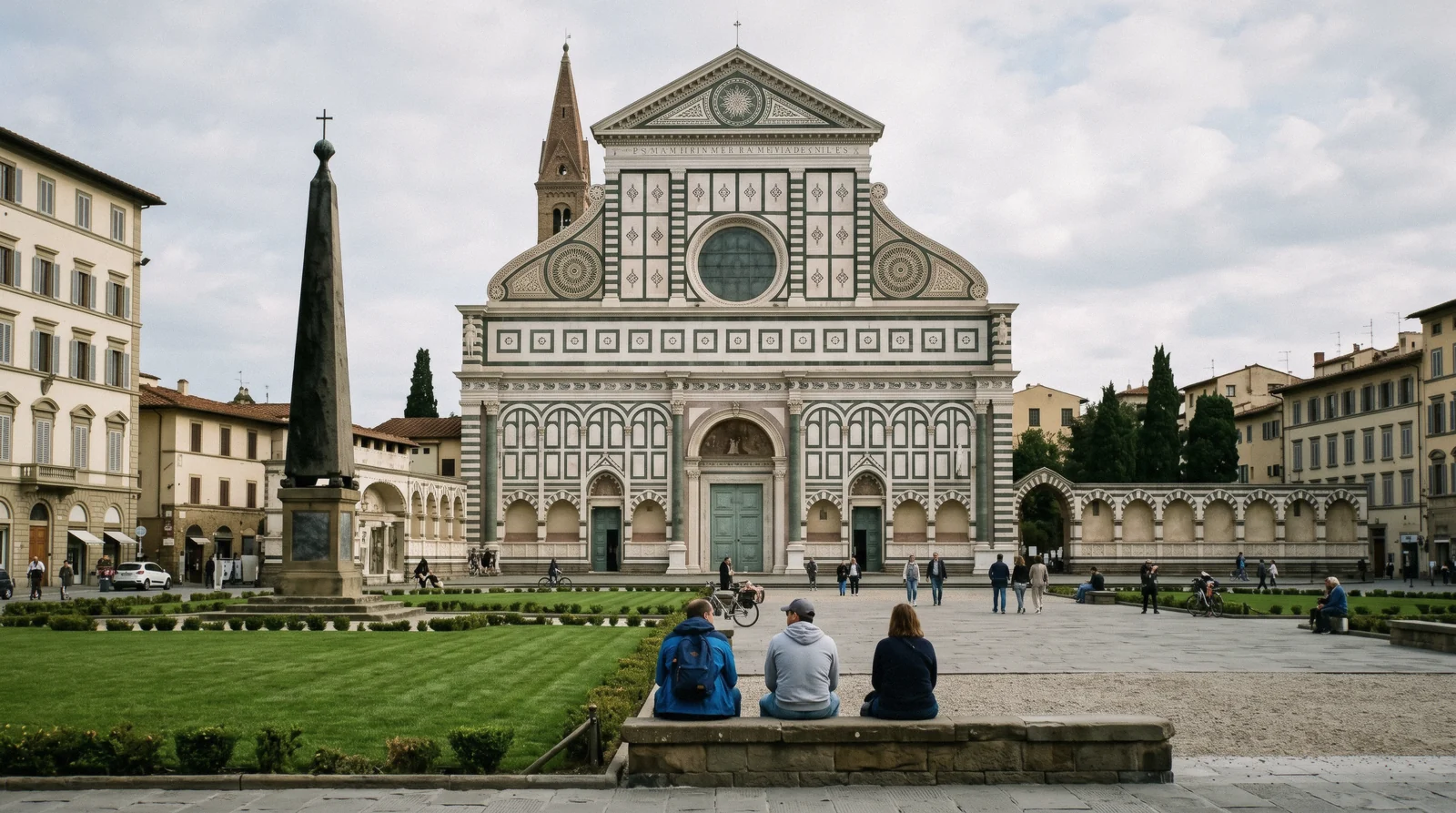
Santa Maria Novella, Florence
Santa Maria Novella Florence is the Dominican basilica at the western end of the centre, the one with Leon Battista Alberti's green-and-white marble façade on the piazza and Masaccio's Holy Trinity inside. One ticket of €7.50 (about $9) covers the church, three cloisters, the Spanish Chapel and the refectory. The city's main railway station borrows its name from the church and stands three minutes behind it — trains and left luggage are on the getting around page, and the rest of the city is on what to see in Florence; this page is the basilica.
Quick answer One ticket, hours that change every weekday, and the pharmacy round the corner
Santa Maria Novella costs €7.50 (about $9) for the basilica, the cloisters, the Spanish Chapel and the refectory on one ticket, and needs no booking — the office is on site. The catch is the timetable: it changes with the day of the week, and Friday and Sunday open late.
Key takeaways
- Monday to Thursday 09:00–17:30, Friday from 11:00, Saturday until 17:00, Sunday 13:00–17:00, last admission an hour before closing — the full weekday table also lists the seven days a year the church shuts.
- Masaccio's Holy Trinity is the work the basilica leads with, and Ghirlandaio's Tornabuoni frescoes and Andrea di Bonaiuto's Spanish Chapel take the rest of the hour — what to look at and where it hangs.
- The Officina Profumo-Farmaceutica at Via della Scala 16, a pharmacy since 1612, is three minutes away and sells no ticket; the €13.90 Medici tales walk covers this side of town on foot, and the station of the same name is three minutes the other way.
Key facts
Opening hours
| Monday–Thursday | 09:00–17:30 |
|---|---|
| Friday and civil holidays | 11:00–17:30 |
| Saturday and eves of religious holidays | 09:00–17:00 |
| Sunday and religious holidays | 13:00–17:00 |
Closed 1 January, 6 January, 15 August, 1 November, 8 December, 25 December and Easter; Good Friday and Holy Saturday open for prayer only. Some August–September 2026 dates close early at 15:00 (site alert)
Admission
- Adult
- €7.50 (about $9)
- Reduced
- €5 ages 11–17 with ID (about $6); €12 (about $14) on special-event days
- Free
- Under 11, Florence residents, visitors with a disability and their carer, clergy and religious, one school leader per fifteen pupils, licensed Italian guides, ICOM, ICOMOS and ICCROM members. The basilica is free at any time for personal prayer and during services
Planning it
- Time needed
- Not stated by the basilica; our routing: 1 h for the church, 1 h 30 with the cloisters and the Spanish Chapel
- Book ahead
- Optional — walk-up usually fine
- Address
- Piazza Santa Maria Novella 18, 50123 Firenze
Walks that pass the basilica
The basilica ticket is sold by the church itself, €7.50 (about $9) at the office on site or online through the Comune, and one ticket covers the basilica, both cloisters, the Spanish Chapel, the Ubriachi Chapel and the refectory. These are the two guided walks we list that work this side of town.
Do you want the station side of the centre explained, or a first morning that ends at the Duomo?
| Option | Price | Includes | Booking | Book |
|---|---|---|---|---|
| Medici tales walking tour, 2 hoursVisitors who want the station-side of the centre explained on a first afternoon | €12 | Guide only — the walk passes the façade and does not enter | Free cancellation to 24 h | Check Availability |
| Highlights walking tour, 1.5 hoursA first morning that ends at the Duomo rather than starting there | €17 | Guide only — no basilica entry included | Free cancellation to 24 h | Check Availability |
Neither walk enters the basilica. Their listings do not include the ticket, so buy it on site and take the walk separately. Prayer and services are free at all times, but that is not a visit: the cloisters stay behind the ticket. Figures current in Q3 2026.
Walks that start on this side of town
Three walks whose meeting points sit within a few minutes of the piazza — the street-food tour gathers at Piazza dell'Unità Italiana, right behind the church. Prices, ratings and review counts are the platform's own. More eating walks are on the Florence food tours page.
 from €12
Top rated
from €12
Top rated
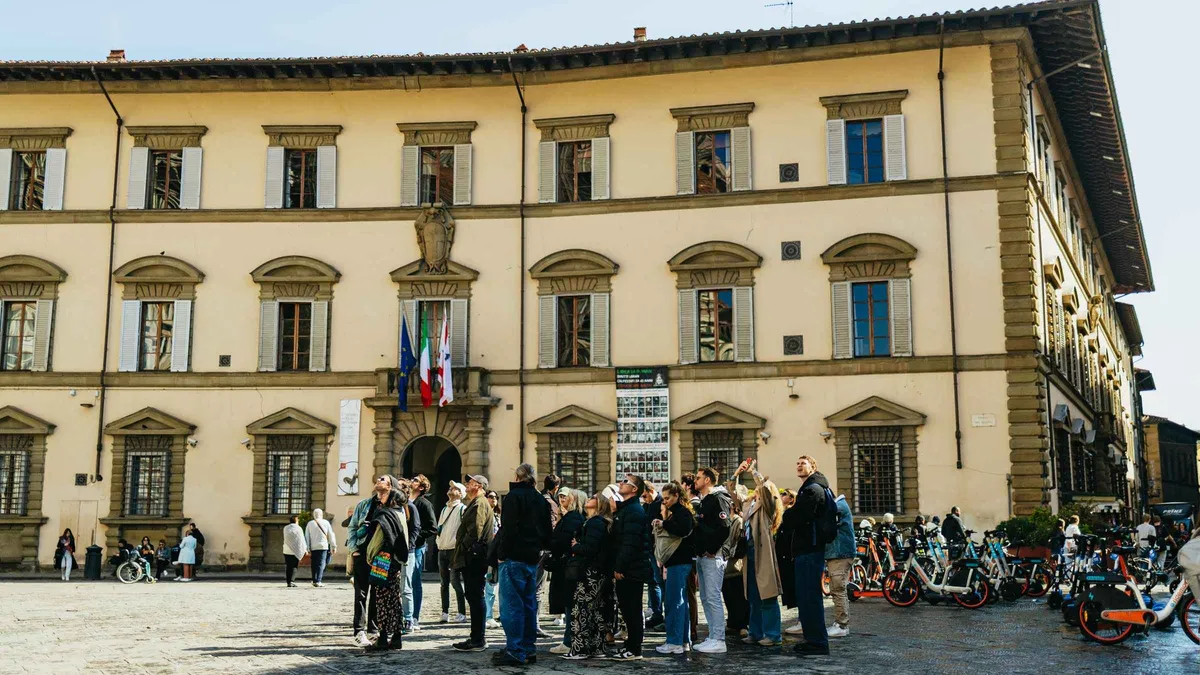
Florence: Renaissance and Medici Tales Guided Walking Tour
listed at $13.90
Two-hour storytelling walk on the Medici and the Renaissance in English or Spanish, ending with local eating and shopping tips. Cheapest tour here.
Check Availability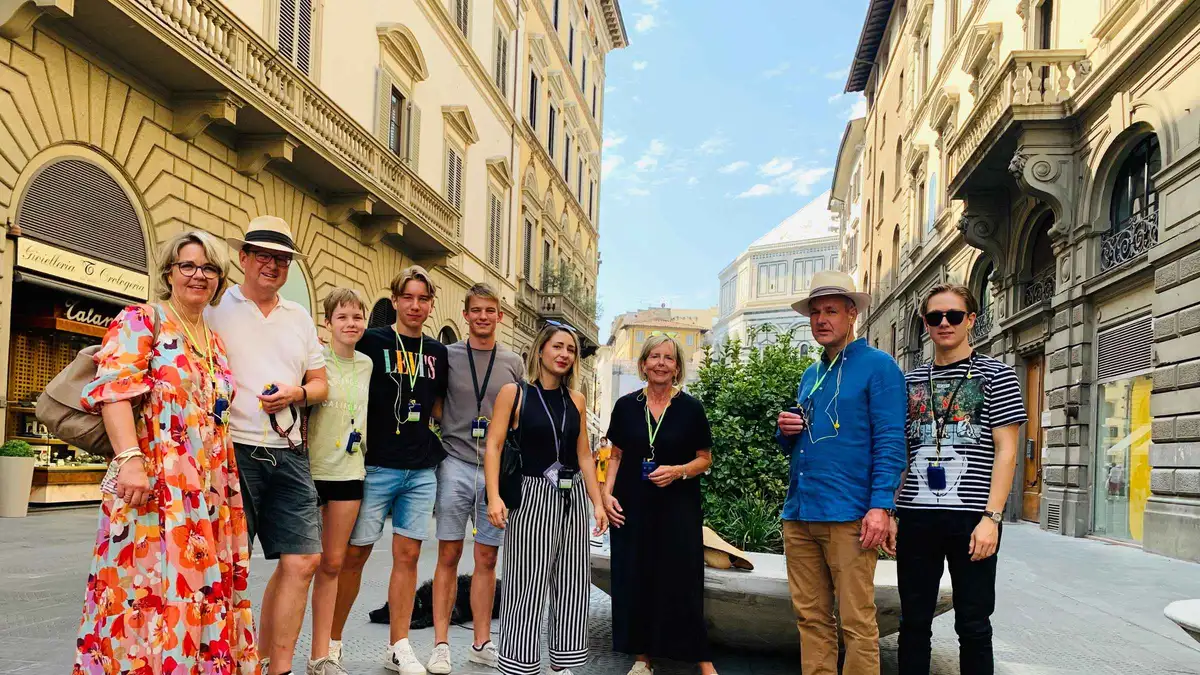 from €17
Florence: Highlights Walking Tour with Expert Guide
listed at $20.27
90-minute small-group highlights walk (Duomo, Piazza della Signoria, Ponte Vecchio) in 8 languages, with free luggage storage. Runs rain or shine.
Check Availability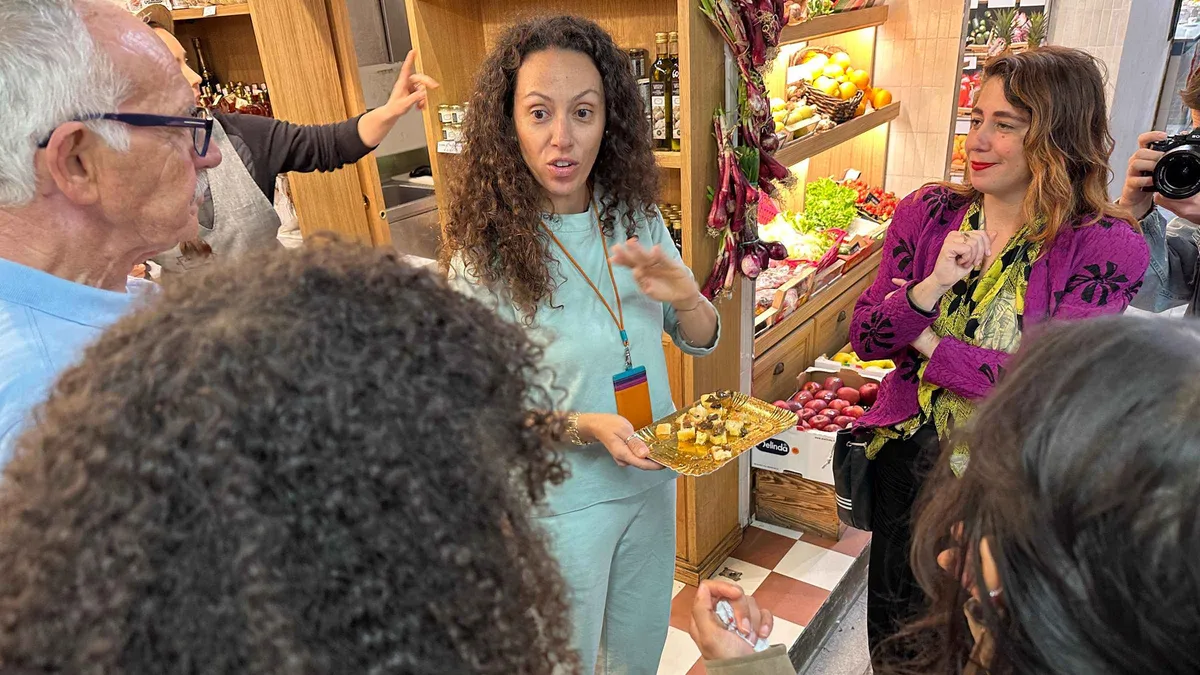 from €42
Top rated
from €42
Top rated
Florence: Street Food Tour with Wine & Local Guide
listed at $48.65
2.5-hour street-food walk through San Lorenzo Market and the Duomo area with several tastings and a sip of wine; morning only, no vegan or gluten-free.
Check AvailabilityPrices, ratings and details are the platform's own. Dollar figures are the listed prices. The platform bills in your account's currency.
What it is: the Dominican church, 1279 to 1470
Two building campaigns two centuries apart produced one of the strangest façades in Italy: a Gothic lower half and a Renaissance upper half that somehow agree.
The Dominicans arrive, 1221
The Dominicans were given the small church of Santa Maria delle Vigne, then outside the city walls, in 1221. The present basilica was begun around 1276–1279 and consecrated in 1420. Its plan is a preaching church like Santa Croce at the opposite end of the centre, and the two orders effectively bracketed medieval Florence between them, Franciscans east and Dominicans west.
In 1439 the Council of Florence, the attempt to reunite the Latin and Greek churches, sat in this building. Vasari remodelled the interior in 1567 for Cosimo I, shortening the side chapels — the same tidying-up operation he carried out at Santa Croce.
Alberti's façade for Giovanni Rucellai, 1470
The lower half, in white marble and green serpentino from Prato, dates from about 1350. Giovanni Rucellai paid Leon Battista Alberti to finish the front, completed in 1470: a classical temple front stacked on a Gothic base, tied together by the two great scrolls at the sides. Those scrolls solved the problem of a high nave meeting low aisles, and church builders copied them across Italy for the next two centuries.
On the façade are Ignazio Danti's astronomical instruments of 1572 — an armillary sphere and a quadrant, set up by a Dominican friar-astronomer whose calculations fed into the Gregorian calendar reform ten years later.
What to see: Masaccio's Trinity first
The basilica names its own highlights, and the first of them is a fresco most visitors walk past because it is on a side wall rather than over an altar.
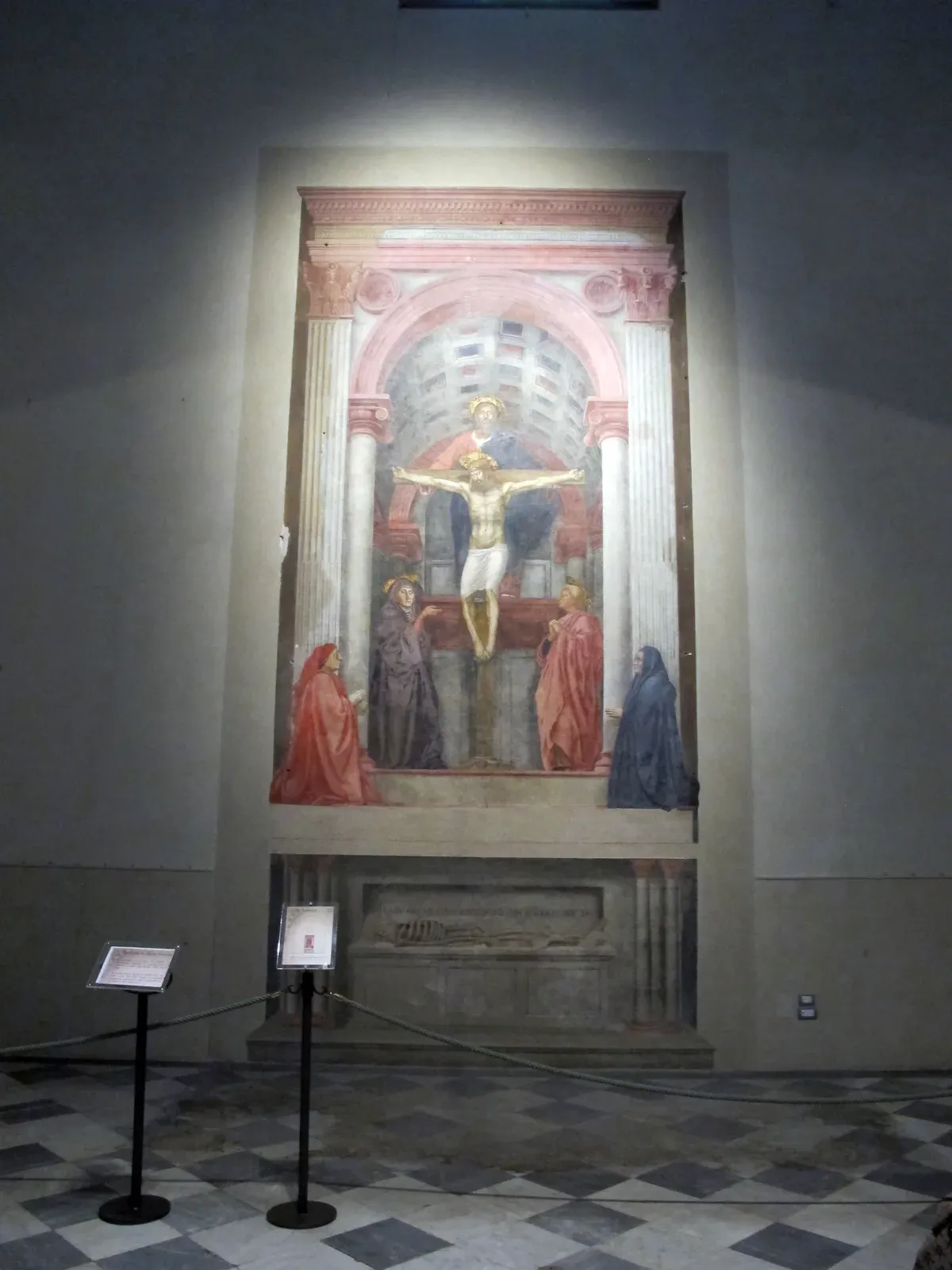
Photo: sailko, CC BY-SA 3.0, via Wikimedia Commons (https://creativecommons.org/licenses/by-sa/3.0)
The Holy Trinity, left aisle
Masaccio's Holy Trinity, painted in the mid-1420s, is the first monumental painting built on a single, mathematically constructed vanishing point: a barrel-vaulted chapel that is not there, cut into a flat wall. Stand back to the middle of the nave and the coffered vault opens; step to the side and it collapses. Below, a painted skeleton on a tomb carries the line telling the viewer that what he is, you will be.
Giotto's painted Crucifix, from around 1290, hangs in the nave; Brunelleschi's wooden Crucifix of about 1410–15 is in the Gondi Chapel — the one Vasari says he carved to answer Donatello's, whose original is over at Santa Croce.
The Tornabuoni Chapel: Ghirlandaio, 1485–90
The main chapel behind the high altar was frescoed by Domenico Ghirlandaio and his workshop between 1485 and 1490 with the lives of the Virgin and John the Baptist, staged in the houses and clothes of contemporary Florence — the Tornabuoni family are in the crowd scenes. A teenaged Michelangelo was apprenticed in that workshop while the scaffolding was up. Giambologna's bronze crucifix stands on the altar in front of it.
The Strozzi chapels, and the pulpit Galileo was denounced from
The Filippo Strozzi Chapel was frescoed by Filippino Lippi in 1502, in the strange, over-heated late style that reads more like Rome than Florence. The Strozzi di Mantova Chapel in the transept keeps Nardo di Cione's Last Judgement, Hell and Paradise of 1350–57, painted with Dante's poem open beside the painter.
The pulpit on the third nave pier, designed by Brunelleschi and carved by Buggiano in 1443, is where a Dominican friar first denounced Galileo's Copernicanism from the pulpit in 1614 — a fact worth carrying across town to the Museo Galileo, which holds his instruments.
The cloisters, the Spanish Chapel and the refectory
The Green Cloister takes its name from the terra verde pigment of Paolo Uccello's Flood frescoes, damaged and ghostly but still readable. Off it is the Spanish Chapel, the Dominican chapter house frescoed by Andrea di Bonaiuto in 1365–67 with the whole Dominican programme on four walls, including a black-and-white dog pun on the order's name. The refectory holds Plautilla Nelli's Last Supper, a large signed painting by a sixteenth-century Dominican nun, restored and hung in 2019.
These rooms take the second half of your hour and empty out much faster than the nave.
Hours by weekday, and the days it shuts
Santa Maria Novella changes its opening time four times across a week, which is the single most common reason people arrive at a locked door. The table below is straight from the basilica's own visit page, with the last-admission rule applied to every row.
Last admission is one hour before closing on every day, so the practical cut-off is 16:30 from Monday to Friday and 16:00 on Saturday and Sunday. Friday's 11:00 start and Sunday's 13:00 start are the two that catch visitors who planned a morning here. Seven dates a year are closed altogether: 1 January, 6 January, 15 August, 1 November, 8 December, 25 December and Easter Sunday.
On Good Friday and Holy Saturday the basilica opens for prayer only, which means no cloisters and no Spanish Chapel. The site was also carrying an alert about early 15:00 closures on some August and September 2026 dates — check it on the day you plan to go. Groups are capped at twenty-five people plus the guide, and headsets are required from six people up.
Personal prayer and attendance at services are free at any hour the church is open for them.
- Quietest slot: Monday to Thursday at 09:00
- Worst plan: Friday or Sunday morning — the doors are shut until 11:00 and 13:00
- Groups: maximum 25 plus guide; headsets required from 6 people
| Day | Opens | Closes | Last admission |
|---|---|---|---|
| Monday–Thursday | 09:00 | 17:30 | 16:30 |
| Friday and civil holidays | 11:00 | 17:30 | 16:30 |
| Saturday and eves of religious holidays | 09:00 | 17:00 | 16:00 |
| Sunday and religious holidays | 13:00 | 17:00 | 16:00 |
| Good Friday, Holy Saturday | Prayer only | Prayer only | No visits |
| 1 and 6 January, 15 August, 1 November, 8 December, 25 December, Easter | Closed | Closed | — |
The pharmacy at Via della Scala 16
The Officina Profumo-Farmaceutica di Santa Maria Novella grew out of the same convent and is a three-minute walk from the church door. It is a shop, not a museum, and it is worth being clear about that before you go.
The Dominicans were here from 1221 and were distilling and compounding for the convent long before the doors opened to the public on 15 October 1612. The rooms you can walk through today are the entrance corridor, the Sala Grande — the former Chapel of San Niccolò of 1332, refitted in neo-Gothic dress between 1848 and 1858 — the Sacrestia, used as a storeroom from 1612, the Antica Spezieria that was the sales room from 1612 to 1848 and now houses the herbalist, and the Sala Verde of 1335–37.
The company's own page describes about three thousand visitors a day. No ticket is sold and no opening hours are stated on the pages we fetched, so treat it as retail: walk in, look at the vaulted rooms and the cases, and buy something or not. If somebody sells you a "pharmacy tour ticket", that is their tour, not an entry fee.
Going from the basilica: out of the piazza on the north-west corner, along Via della Scala, and it is on the left at number 16.
- Via della Scala 16, three minutes from the basilica
- Public pharmacy since 15 October 1612; convent on the site from 1221
- No ticket sold; hours not stated on the official pages we fetched
The piazza: obelisks on bronze tortoises
The square in front of the church was laid out as a racecourse. From 1563 until the late nineteenth century the Palio dei Cocchi, a chariot race, ran here on the eve of the feast of St John, and the two marble obelisks marked the turns. They stand on bronze tortoises cast by Giambologna's workshop in 1608, which is the detail to look for at ground level — four small tortoises taking the weight of each obelisk.
Around the base of the façade run the avelli, the arcaded family tombs of the medieval city. Domenico Ghirlandaio, who frescoed the main chapel inside, is buried in one of them. The piazza itself is open at all hours and free; it is one of the few large squares in Florence with grass and benches, and it fills with people at lunchtime.
How to get there — and the station of the same name
The visitor entrance is on Piazza Santa Maria Novella 18, on the piazza side, not through the great central doors. Florence's main railway station, Firenze Santa Maria Novella, is named after the church and stands about three minutes behind it, on Piazza della Stazione; if you have just got off a train, you are already there. Trains, trams, left luggage and airport connections are covered on the getting around page — this page does not deal with the station.
From the Duomo it is a ten-minute walk down Via de' Cerretani. An urban bus or tram ticket costs €2 (about $2.30) and covers 90 minutes under the fares in force from 1 August 2026, or €3 bought on board; the T1 and T2 tram lines both call at the station. The centre is a ZTL, closed to unauthorised cars Monday to Friday 07:30–20:00 and Saturday 07:30–16:00, and the station car parks are the nearest legal option if you are driving.
- Visitor entrance: Piazza Santa Maria Novella 18
- Firenze S.M.N. station: 3 minutes behind the church
- 10 minutes on foot from the Duomo via Via de' Cerretani
- Bus or tram €2 (about $2.30), valid 90 minutes; €3 on board
Santa Maria Novella map: church, pharmacy, station
The visitor entrance, the pharmacy three minutes away, the station behind, and the two stops most people walk to next.
Next stop from Santa Maria Novella
Walk minutes are our estimates from the GPS distances; everything here is on the same side of the centre, so this church pairs naturally with San Lorenzo and the market.
San Lorenzo
Brunelleschi's basilica with the Old Sacristy, €9 (about $11), open Monday to Saturday and closed on Sundays. San Lorenzo is the second church of this quarter and the one the market wraps around.
8 min walkMercato Centrale
Via Panzani then Via Faenza brings you to the iron-and-glass food hall. Mercato Centrale is free to walk into and the obvious lunch after a morning here.
10 min walkDuomo
Straight down Via de' Cerretani. The cathedral nave is free Monday to Saturday 10:15–15:45 and closed to visitors on Sundays — the Duomo complex page has the passes for the dome and the bell tower.
10 min walkSanta Maria Novella questions
Is Santa Maria Novella free to enter?
Not as a visit. A ticket costs €7.50 (about $9), €5 for ages 11 to 17, and is free for under-11s, Florence residents, clergy and licensed Italian guides. The basilica is open free of charge for personal prayer and during services, but that does not include the cloisters, the Spanish Chapel or the refectory. All the ways in are in the table.
What is the most famous painting in Santa Maria Novella?
Masaccio's Holy Trinity in the left aisle, painted in the mid-1420s and the first monumental painting constructed on a single vanishing point. Giotto's Crucifix and Ghirlandaio's Tornabuoni Chapel frescoes are the other two the basilica names first. Where each of them hangs.
How long does it take to visit Santa Maria Novella?
The basilica does not publish a figure. Our routing is an hour for the church itself and an hour and a half if you give the Green Cloister, the Spanish Chapel and the refectory the time they deserve — and they are the part most visitors skip. The two-hour Medici tales walk covers the outside of the church and the quarter, not the interior.
Is Santa Maria Novella open on Sunday?
Yes, but only from 13:00 to 17:00, with last admission at 16:00. Friday is the other late start, at 11:00. Monday to Thursday it opens at 09:00, which is the quiet slot. The full weekday table also lists the seven dates a year it shuts completely.
Is the Santa Maria Novella pharmacy free to visit?
No ticket is sold at Via della Scala 16 — it is a shop, and you walk in as a customer. The official pages we fetched do not state opening hours, so check smnovella.com on the day. The historic rooms, including the 1332 chapel turned Sala Grande, are part of the retail space. More about the pharmacy and its rooms.
Is Santa Maria Novella the same as the train station?
The station is named after the church and stands about three minutes behind it, on Piazza della Stazione. They are two different places with one name: the basilica is the Dominican church on the piazza, Firenze S.M.N. is the terminus. Trains, trams and left luggage are on the getting around page.
Is Santa Maria Novella a good area to stay in Florence?
It is the area most first-time visitors end up in, because it is next to the station and walkable to everything — the piazza side is calmer than the station side. We compare it against the other five districts by walking minutes on the where to stay page.
What does the Santa Maria Novella ticket include?
One ticket covers the basilica, the Cloister of the Dead, the Green Cloister, the Spanish Chapel, the Ubriachi Chapel and the refectory — a single admission since 2012, with no cheaper church-only option. The ticket is €7.50 (about $9). The churches page sets it beside the other Florence churches, from Santa Croce to San Miniato al Monte on the hill.
Santa Maria Novella on video
Three films that show the façade, Masaccio's Trinity and the cloisters before you decide how much of your hour goes where.
The basilica explained
A guided run through the interior: Masaccio's Trinity, the Tornabuoni Chapel and the Strozzi chapels in order.
Video: Rocky RuggieroAlberti's façade, and why the scrolls are there
Ten minutes on the 1470 front and the problem those two great volutes were invented to solve.
Video: SmarthistoryVirtual walk through the church and cloisters
A 4K walk that includes the Green Cloister and the Spanish Chapel — the half of the ticket most visitors skip.
Video: Shaky PicturesWhere Santa Maria Novella fits in a Florence day
It is a first-morning church. You arrive by train, the basilica is three minutes from the platforms, it opens at 09:00 Monday to Thursday and it costs €7.50 — an hour here orients you before the ticketed queues of the afternoon. Then walk east: San Lorenzo, the market, the Duomo, all within ten minutes.
If you are collecting churches rather than museums, pair it with Santa Croce at the far end of the centre for the tombs and the Pazzi Chapel, and end the day at San Miniato al Monte, which is free and sings vespers at 18:30. Every church in the city with its price, hours, closed day and dress rule is set side by side on the Florence churches page; the three-day itinerary places this one on the first morning, and the full attractions list ranks it against everything else. The rest of the guide starts from Florence attractions.
Prices, hours and terms are set by the venue or operator and confirmed at checkout.
We may earn a commission if you book through one of our links, at no extra cost to you. Full affiliate disclosure