 Florence City Guide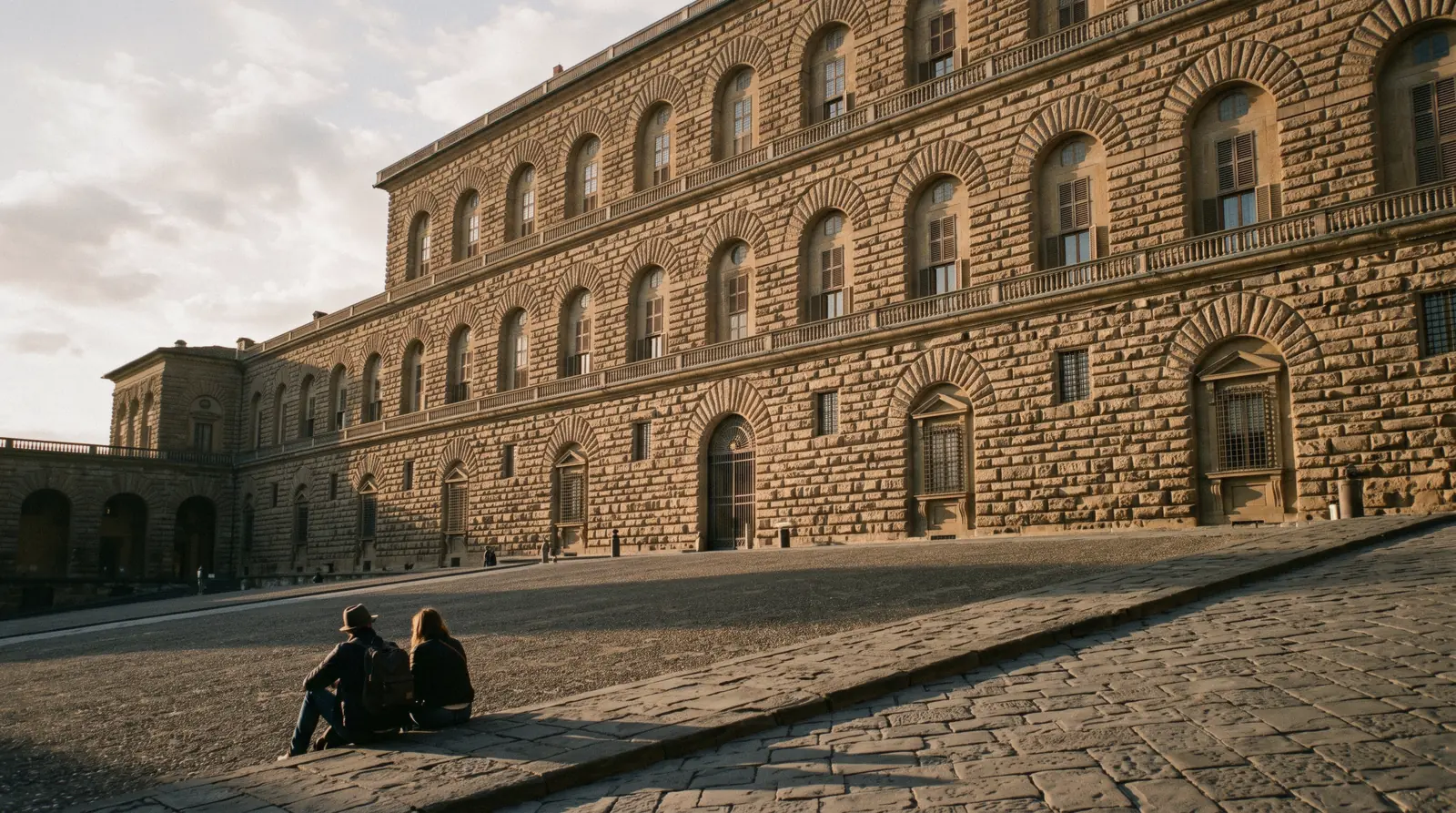
Pitti Palace
Pitti Palace is the vast rusticated block on the south bank of the Arno that the Medici grand dukes made their home in 1549 and the Italian state turned into a stack of museums in 1919. One ticket covers the Palatine Gallery and the rest of them; the garden behind is a separate ticket, and this page sorts out which combination you actually need. It is one of about twenty-five sights we cover across our guide to what to see in florence, and the one with the most ticket combinations to get wrong.
Quick answer Price, hours, what one ticket covers and the Boboli combo — in three lines
Pitti Palace opens Tuesday to Sunday 08:15–18:30 and closes on Mondays, 1 January and 25 December. A reserved palace and Boboli ticket costs €30 (about $35) and covers every gallery inside the building plus the gardens behind it.
Key takeaways
- The Palatine Gallery, the Royal Apartments, the Gallery of Modern Art, the Treasury of the Grand Dukes, the Museum of Costume and Fashion, the Museum of Russian Icons and the Palatine Chapel all sit behind that one price — a combined palace and garden ticket with eBook adds the gardens for a single fee
- The Boboli Gardens behind the palace come on the same voucher. The ticket with eBook at €35 adds the Villa Bardini garden, and the which-ticket section sets out the choices
- If you also want the Uffizi, the five-day pass from €68 (about $79) covers all three, and a three-hour guided tour of the Palatine Gallery and Boboli is the way in for anyone who wants the paintings explained
Key facts
Opening hours
| Tuesday–Sunday, all year | 08:15–18:30 |
|---|---|
| Ticket office, Piazza de' Pitti | 08:15–17:30 |
Closed Mondays, 1 January, 25 December
Admission
- Adult
- €30 palace and Boboli, reserved (about $35), or €35 with Villa Bardini and eBooks (about $41)
- Reduced
- Reduced rate for EU citizens aged 18–25 with ID
- Free
- Under 18, any nationality; first Sunday of each month
Planning it
- Time needed
- Not stated by the museum; our routing: 2 h for the Palatine Gallery and the Royal Apartments, 3–4 h to add Modern Art and Costume
- Book ahead
- Recommended — a few days
- Address
- Piazza de' Pitti, 50125 Firenze (street number not stated on the official page)
Four ways into Pitti Palace
Four ways into Pitti Palace from the cards on this page, at the prices GetYourGuide and Tiqets list. Each one adds the Boboli Gardens, a guide or the Uffizi to the palace itself.
Is this the palace, or the palace and the garden behind it?
| Option | Price | Includes | Cancel | Book |
|---|---|---|---|---|
| Palace + Boboli ticket with eBookAnyone doing both in a day who also wants Villa Bardini | €35 (about $41) | Palace museums, Boboli and Villa Bardini gardens, eBooks | Non-refundable | Check Availability |
| Palace + Boboli reserved entry, TiqetsVisitors who want palace and gardens on one voucher with an audio guide | €30 (about $35) | Both sites on one voucher, city audio guide | Nonrefundable | Check Availability |
| Guided tour, 3 hPeople who want the Palatine hang explained rather than walked past | From €85 | Palatine Gallery and Boboli with a licensed guide | Free up to 24 hours before | Check Availability |
| Uffizi + Pitti + Boboli, 5 daysAnyone spreading the Uffizi, Pitti and Boboli across five days | From €68 | One timed Uffizi slot, then the palace and gardens over 5 days | Non-refundable | Check Availability |
The two palace-and-gardens tickets are either/or: the Tiqets voucher at €30 (about $35) with a Florence city audio guide, or the GetYourGuide ticket at €35 (about $41) that adds Villa Bardini and eBooks. Card prices move with the date and the operator. Treat them as the price you pay only once the checkout shows it. Figures current in Q3 2026.
Pitti Palace tickets and tours compared
Five listings we track for this palace, with platform prices in euro, converted from the listed figure. Each card opens the seller's own calendar, which is the only place that knows what is still free on your date.
 from €35
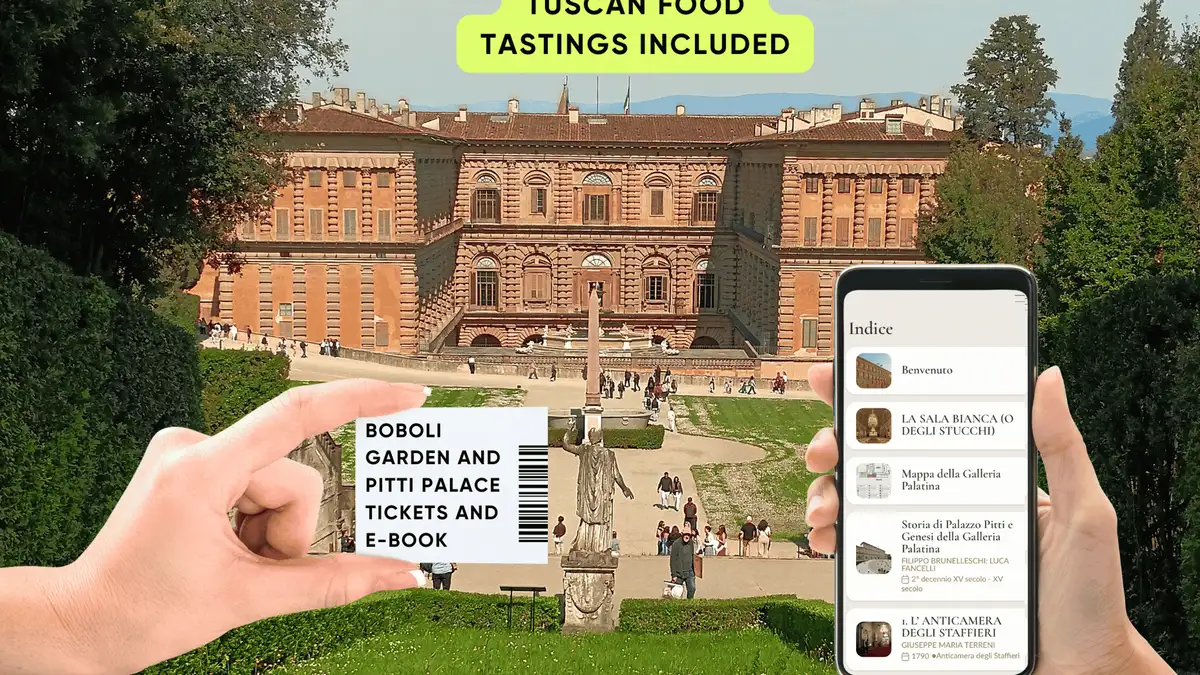
Florence: Pitti Palace and Boboli Gardens Ticket & eBook
listed at $40.87
Combo ticket for Pitti Palace's 7 museums, Boboli Gardens and Villa Bardini garden, with multilingual eBooks sent by WhatsApp or email. Non-refundable.
Check Availability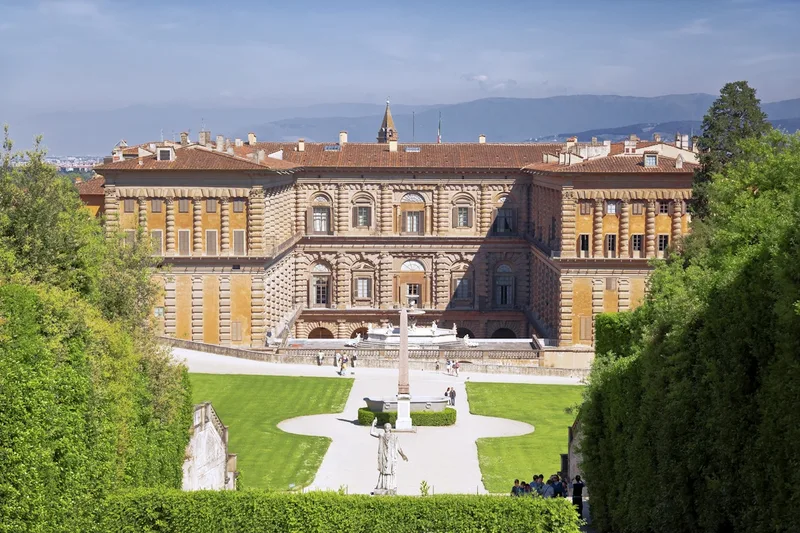 from €30.00
Palazzo Pitti & Boboli Gardens: Reserved Entrance + Florence City Audio Guide
Palace and gardens on one reserved voucher for €30, booking fee inside. Entry is through the Cortile della Dispensa side door, ID is checked, and the gardens shut on the first and last Monday of the month.
Check Availability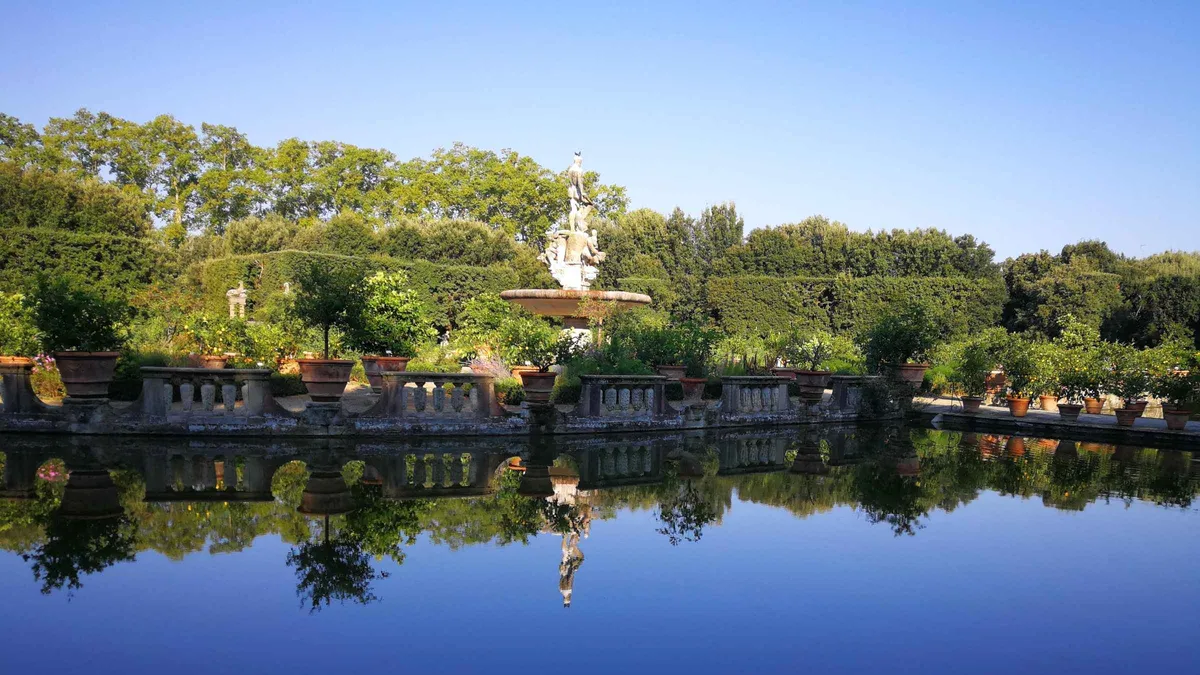 from €85
Top rated
from €85
Top rated
Florence: Pitti Palace, Boboli Garden, Palatine Gallery Tour
listed at $99.90
Three-hour licensed-guide tour of Pitti Palace, the Palatine Gallery and Boboli Gardens with timed tickets; English only, starting at Piazza Pitti.
Check Availability from €68
Florence: Uffizi, Pitti Palace & Boboli Combined 5-Day Pass
listed at $79.23
One timed Uffizi entry that unlocks Pitti Palace and Boboli Gardens over 5 days, with an Uffizi audio app. Combo ticket must be kept; non-refundable.
Check Availability from €68
Florence: Uffizi, Pitti, Boboli and 7 Attractions 5-Day Pass
listed at $79.93
Digital 5-day pass: timed Uffizi entry plus Pitti Palace, Boboli and more, straight to Uffizi entrance 1 with no voucher exchange. Non-refundable.
Check AvailabilityPrices, ratings and details are the platform's own. Dollar figures are the listed prices. The platform bills in your account's currency.
What Pitti Palace is: a banker's house that three dynasties took over
Pitti Palace is famous for three things, and they arrived in that order: it is the biggest palace in Florence, it was the home of the Medici grand dukes and every ruler of Tuscany after them, and since 1919 it has held the Palatine Gallery — one of the great picture collections of Europe, still hung the way its owners hung it. The sequence below explains why the rooms inside jump from Renaissance frescoes to Empire-style throne rooms without warning.
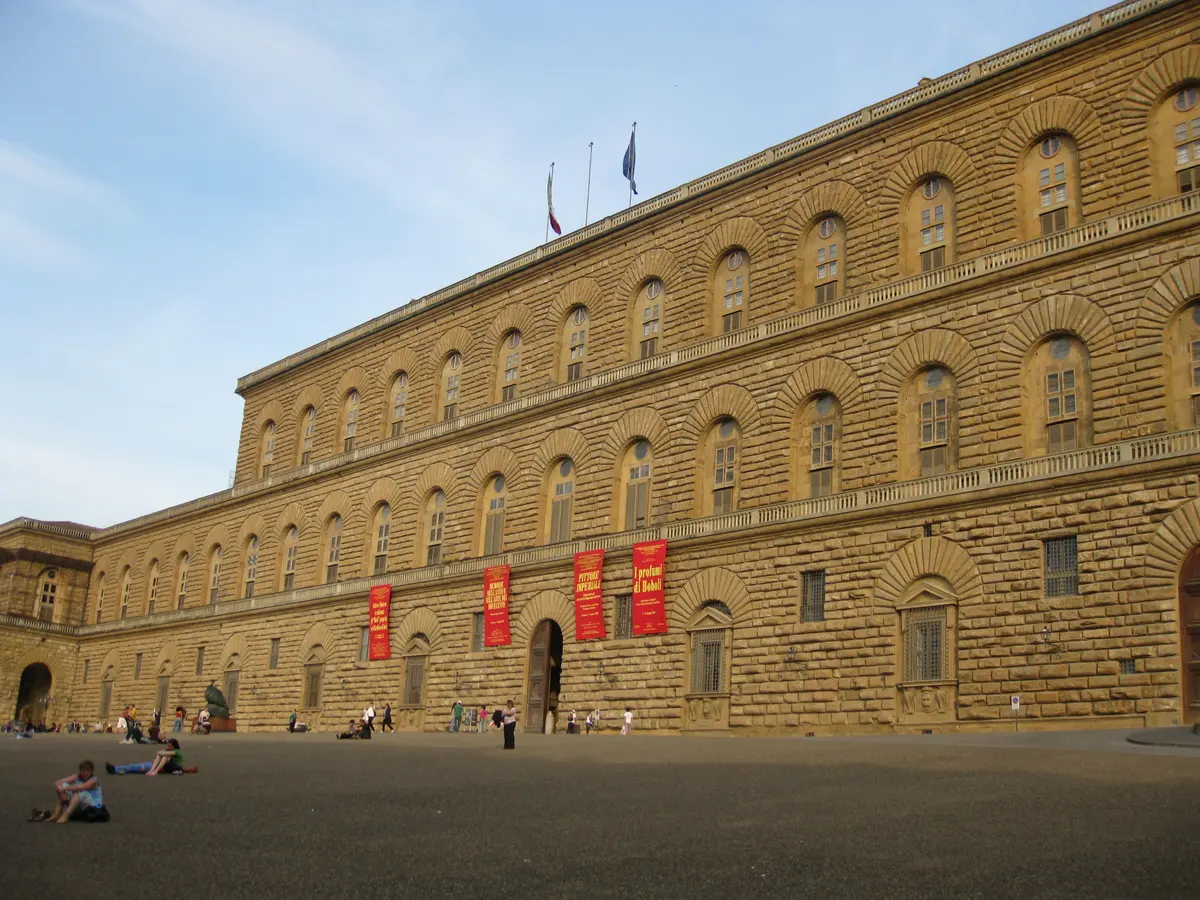
Photo: Deror avi, CC BY-SA 3.0, via Wikimedia Commons (https://creativecommons.org/licenses/by-sa/3.0)
1458: Luca Pitti, and the architect who could not have built it
The core of the palace dates from 1458, when the Florentine banker Luca Pitti (1398–1472) commissioned a town residence on the far side of the Arno. Vasari later credited Brunelleschi with the design, which is impossible — Brunelleschi died twelve years before construction began — and the work is now generally given to his pupil Luca Fancelli.
The severity is the point. Three repeated rows of seven arch-headed openings in rusticated stone read more like a Roman aqueduct than a palace front, and the formula was simply extended each time the building grew, which is why a structure enlarged over three centuries still looks like one idea. Work stopped in 1464 when Pitti's finances collapsed after the death of Cosimo de' Medici, and he died in 1472 with the house unfinished.
1549: Eleonora di Toledo buys it, and Vasari doubles it
The unfinished palace was sold in 1549 to Eleonora di Toledo, wife of Cosimo I de' Medici. Cosimo had Giorgio Vasari enlarge it with a new block along the rear, more than doubling the building, and it was Vasari who then ran the raised walkway from the seat of government through the Uffizi and over Ponte Vecchio to the new residence — the Vasari Corridor, still sold as its own ticket today, which ends by dropping you into the gardens behind this palace.
At first the family kept sleeping at Palazzo Vecchio and used Pitti for guests and court functions. It was their son Francesco I, with his wife Johanna of Austria, who moved in permanently and brought the art collection with him.
Lorraine, Napoleon, Savoy — and the gift of 1919
When Gian Gastone de' Medici died in 1737 the male line ended and Tuscany passed to the Habsburg-Lorraine grand dukes, with Napoleon using the palace during his control of Italy. The House of Savoy inherited it in 1860, and when Florence was briefly the capital of the Kingdom of Italy, Victor Emmanuel II lived here until 1871 — the throne room in the Royal Apartments was decorated for him.
His grandson Victor Emmanuel III presented the palace to the nation in 1919. The state then split the interior into separate galleries, which is the arrangement you buy a ticket for today: about 140 rooms open to the public, most of them decorated later than the shell that holds them.
What is inside, and how much of it you can realistically do
One ticket opens everything in the building, which sounds generous until you are standing in the courtyard deciding where to start. The order below is the one that works if you have half a day: the Palatine Gallery first while your attention is fresh, then whatever you have appetite for.
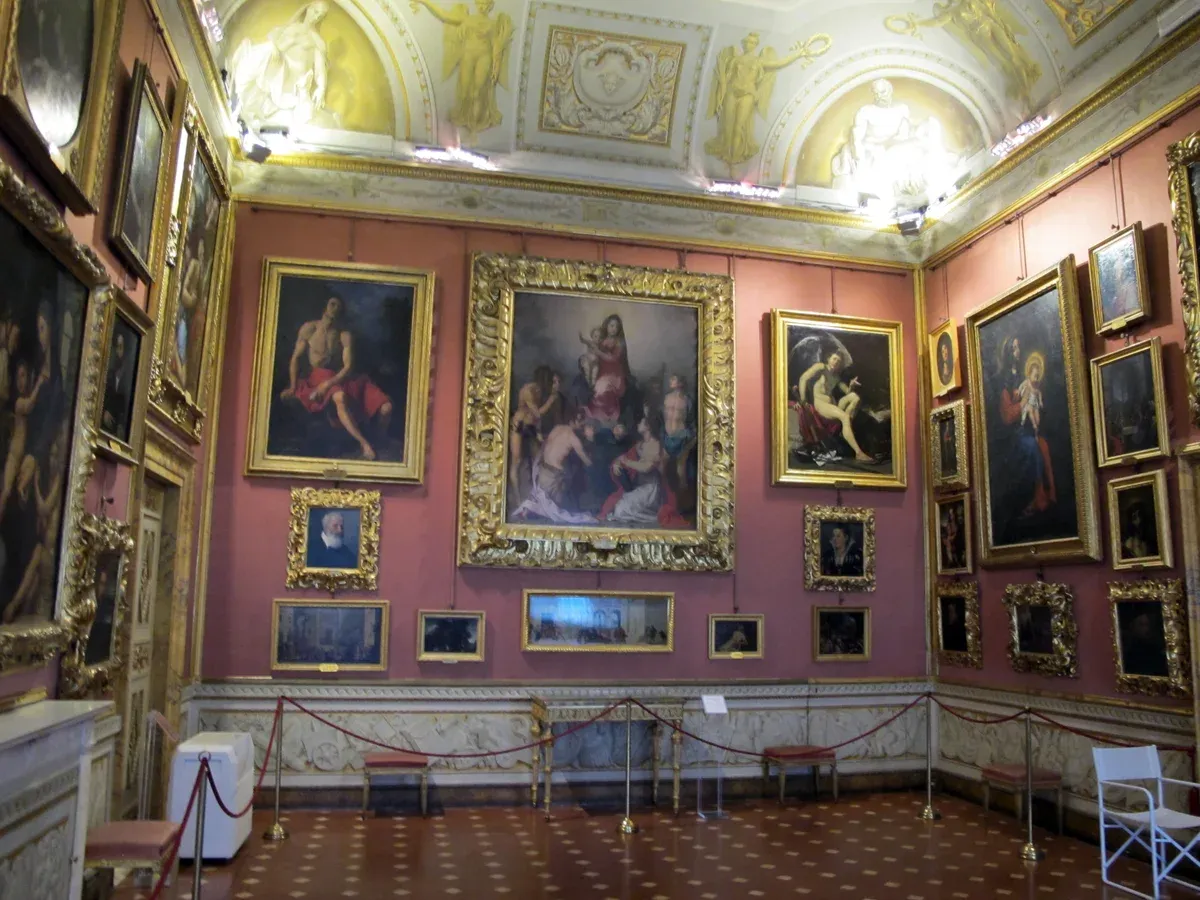
Photo: Sailko, CC BY 3.0, via Wikimedia Commons (https://creativecommons.org/licenses/by/3.0)
The Palatine Gallery: 28 rooms hung the way a private collection was hung
The main gallery holds over 500 principally Renaissance paintings across 28 rooms, and it is deliberately not arranged by school or date. Canvases are stacked frame to frame up the walls of the rooms they were bought for, which is disorienting for twenty minutes and then becomes the reason to come: this is a grand-ducal collection still in its own furniture.
Raphael is the reason most people are here. The Madonna della Seggiola (1516) and the Portrait of Agnolo Doni (1506) hang in the Room of Saturn, the Portrait of Tommaso Inghirami with them; La Velata (1516) is in the Room of Jupiter, alongside work by Rubens, Andrea del Sarto and Perugino. Titian, Correggio and Pietro da Cortona are through the same enfilade.
The Planetary Rooms, and the ceilings that inspired Versailles
The five state rooms at the front of the piano nobile were frescoed by Pietro da Cortona in the high baroque: Venus, Apollo, Mars, Jupiter — the Medici throne room — and Saturn, sequenced by Ptolemaic cosmology. Cortona began in the small Sala della Stufa with the Four Ages of Man, the Age of Gold and the Age of Silver in 1637, Bronze and Iron in 1641; he left Florence in 1647 and his pupil Ciro Ferri finished the cycle by the 1660s.
Those ceilings went on to inspire the Planet Rooms at Louis XIV's Versailles, designed by Charles Le Brun. Look up in the Room of Jupiter before you look at La Velata; almost nobody does, and the ceiling is the better argument for the ticket.
The Royal Apartments: 14 rooms in Savoy Empire style
The Royal Apartments run off the Palatine Gallery — fourteen rooms, largely redecorated in Empire style by the Savoy monarchs, though some Medici-era decoration and furniture survives. The Green Room was frescoed by Castagnoli in the early nineteenth century and holds a seventeenth-century intarsia cabinet; the throne room, done for Victor Emmanuel II, is red brocade and Chinese and Japanese vases. Sustermans portraits of the Medici hang throughout.
These rooms are the smallest step in the visit: they open straight off the gallery and add perhaps twenty-five minutes.
Treasury of the Grand Dukes, Costume, Modern Art, Russian Icons
The Treasury of the Grand Dukes, long called the Silver Museum, holds silverware, ivories, cameos and hardstone work including Lorenzo de' Medici's ancient vases with their fifteenth-century silver-gilt mounts, plus a room of curiosities with a pre-Columbian jade mask. Its most spectacular ceilings are the 1635–1636 frescoes by Giovanni da San Giovanni. The mezzanine of the Treasury is closed until further notice, a notice posted on the official page. The ground-floor rooms are open.
The Museum of Costume and Fashion, in the Palazzina della Meridiana wing, was founded in 1983 and is the only museum in Italy tracing the history of Italian fashion; among its exhibits are the sixteenth-century funeral clothes of Cosimo I, Eleonora of Toledo and their son Garzia. The Gallery of Modern Art moved into the palace in 1922 and opened to the public in 1928, covering nineteenth- and twentieth-century Tuscan painting — the Macchiaioli are its strength. The Museum of Russian Icons, the Palatine Chapel and the Ammannati courtyard complete the list on the official page.
A palace this size is easier to take in as part of one of the best tours in Florence, where a guide can lead you straight to the Treasury, the Gallery of Modern Art and the other collections under this roof.
The decision, if you only have two hours
Do the Palatine Gallery and the Royal Apartments, skip the rest, and spend the hour you saved in the Boboli Gardens instead. The Palatine is the collection nowhere else in Florence duplicates; Modern Art and Costume are good museums that will still be good on a return trip. If somebody in the party is not a painting person, the gardens are the better half of the combined ticket for them, and the two entrances are 100 metres apart.
A three-hour guided tour makes exactly this split for you — Palatine Gallery, then Boboli, with a licensed guide and the tickets included.
Palace with Boboli, a guided visit, or the five-day pass
Pitti is sold with the Boboli Gardens, as a guided visit, or inside a five-day pass with the Uffizi. Here is what each one covers, at the prices the sellers list.
The rule of thumb is simple. Palace and gardens on one day: the reserved palace and Boboli ticket at €30 (about $35), or the palace and garden ticket with eBook at €35 (about $41), which adds the Villa Bardini garden. Palace, gardens and the Uffizi within five days: the five-day pass from €68 (about $79), which arranges your Uffizi slot and means one checkout instead of three.
The palace does not sell out the way the Uffizi does, so a dated ticket here is about fixing your day rather than beating a queue. Book the date you know you will be on the Oltrarno side.
Free days, reduced tickets and the Firenzecard
Entry is free for under-18s of any nationality with ID, and free for everybody on the first Sunday of each month. EU citizens aged 18 to 25 pay a reduced rate with ID. The first-Sunday queue at Piazza de' Pitti is shorter than the equivalent at the Uffizi, which makes this one of the better free-Sunday museums in the city — the crowd concentrates across the river.
The Firenzecard includes Pitti and lists it as no reservation required, so cardholders walk to the entrance. At €85 for 72 hours the card only makes sense if you are doing six or seven paid sites; two museums and a garden do not get you there.
What each card adds
The palace and garden ticket with eBook covers the palace museums, Boboli and the Villa Bardini garden, with eBooks sent by WhatsApp or email. It is non-refundable, so fix your date first. The Tiqets reserved entry puts the palace and the gardens on one voucher with a downloadable Florence city audio guide.
The two five-day passes, ACCORD's and Slow Tour Tuscany's, both at €68, bundle the Uffizi slot with the palace and gardens. What they buy is the Uffizi arrangement: ACCORD meets you by the Cellini statue fifteen minutes before your slot, Slow Tour sends you straight to Uffizi entrance 1 with no voucher exchange. Both are non-refundable.
Hours, the ticket office and the quiet slots
Pitti Palace opens Tuesday to Sunday, 08:15 to 18:30, all year. The ticket office in Piazza de' Pitti closes one hour before the palace does, at 17:30, so plan to be through the door before then.
The palace is closed every Monday, on 1 January and on 25 December. That matters more than it sounds: the Boboli Gardens behind it are open on most Mondays, so a Monday in Florence can still be a Pitti-side day, just an outdoor one. The Monday openings page has the full list of what is running.
Crowding here is nothing like the Uffizi's. Coach groups work through the Palatine Gallery late morning; by 16:30 the salons are close to empty and the light through the front windows is at its best. That is our observation from the pattern of group departures, not a figure the museum publishes.
- Emptiest: the 08:15 opening, or after 16:30
- Ticket office shuts at 17:30 — arrive by 17:00 to buy and get in
- Closed Mondays, 1 January and 25 December; the gardens open most Mondays
- Free for all on the first Sunday of the month, no reservation
How to get there, and which door
The address is Piazza de' Pitti, 50125 Firenze — the sloping square on the Oltrarno side, twenty metres up from Via Guicciardini. The official page does not give a street number, and it does not need to: the façade takes the whole square. On foot from the centre it is the obvious walk.
From Piazza della Signoria cross Ponte Vecchio and keep straight up Via Guicciardini — eight to ten minutes at a normal pace, and the palace appears at the top on your left. From Santa Maria Novella station allow twenty minutes. From 1 August 2026 an urban bus or tram ticket costs €2 (about $2.30) and lasts 90 minutes, bought in the app, at a tobacconist or with contactless on board.
There is one entrance for visitors, through the courtyard off the square, with the ticket office on the left as you face the building. Do not drive: the historic centre is a ZTL, closed to unauthorised cars Monday to Friday 07:30–20:00 and Saturday 07:30–16:00, and Piazza de' Pitti sits inside it.
- 8–10 minutes on foot from Piazza della Signoria across Ponte Vecchio
- 20 minutes on foot from Santa Maria Novella station; urban bus or tram €2, 90 minutes
- One visitor entrance through the courtyard; ticket office on the left in the square
- The garden entrance is inside the same courtyard — you do not leave the building to reach Boboli
Pitti Palace map: the entrance and what is round it
A map of Pitti Palace and its surroundings: the visitor entrance, the garden gate behind it and the three stops within a ten-minute walk on this side of the river. Searches for a Pitti Palace hotel land on a separate business with a similar name — this map is the museum.
Next stop from Pitti Palace
Walk times are our estimates from the GPS distances. The garden gate is inside the palace courtyard, so Boboli costs you no walking at all.
Boboli Gardens
Straight through the courtyard, on the same palace and gardens ticket. The Boboli Gardens guide has the four seasonal closing times and the Mondays it shuts.
1 min walkPonte Vecchio
Downhill along Via Guicciardini. Free, and the Vasari Corridor that once linked this palace to the government runs above the shops — Ponte Vecchio is quietest before 09:00.
5 min walkOltrarno and Santo Spirito
West of the palace: artisan workshops, Piazza Santo Spirito and the Brancacci Chapel with its 30-minute visit limit. The Oltrarno guide maps the district.
5 min walkPitti Palace questions
Is Pitti Palace worth visiting?
If you like paintings, yes: the Palatine Gallery's 500-plus works include four Raphaels, in a collection nobody queues for. A reserved palace and Boboli ticket at €30 (about $35) covers the galleries and the gardens, so if you are museumed out, give most of your time to the Boboli Gardens. The palace and garden ticket with eBook adds Villa Bardini.
Does the Pitti Palace ticket include the garden behind it?
A palace-only ticket does not, but both tickets we list do. The Tiqets reserved entry at €30 (about $35) and the combined ticket with eBook at €35 (about $41) cover the palace galleries and the Boboli Gardens, and the eBook ticket adds the Villa Bardini garden as well.
How long do you need at Pitti Palace?
The museum does not state a visit length. Our routing: two hours for the Palatine Gallery and the Royal Apartments, three to four hours if you add the Gallery of Modern Art and the Costume museum. The three-hour guided tour spends about half its time in the Palatine Gallery and the rest in the gardens, which is a sensible ratio.
Is Pitti Palace open on Monday?
No — it closes every Monday, plus 1 January and 25 December. The Boboli Gardens behind it are open on all but the first and last Monday of the month, and Palazzo Vecchio across the river opens on Mondays too. The Monday openings page lists everything that runs.
Which Raphael paintings are in the Palatine Gallery?
The Madonna della Seggiola (1516), the Portrait of Agnolo Doni (1506) and the Portrait of Tommaso Inghirami hang in the Room of Saturn; La Velata (1516) is in the Room of Jupiter. All four are in the Palatine Gallery, which the standard palace ticket covers — the guided Palatine tour walks that enfilade with a licensed guide.
Did the Medici family live in Pitti Palace?
Yes, from 1549, when Eleonora di Toledo bought the unfinished building, though the family only moved in permanently under her son Francesco I. Their earlier seat was Palazzo Vecchio across the river — which is exactly why that one is called the old palace.
Do I need to book Pitti Palace tickets in advance?
Not to beat a queue: the palace does not sell out the way the Uffizi does. A dated palace and gardens ticket fixes your day, and booking matters most if you are combining it with an Uffizi slot on the five-day pass.
Is the Treasury of the Grand Dukes open?
The ground-floor rooms are; the Treasury's mezzanine is closed until further notice, per the notice on the official page. Nothing is deducted from the ticket price for it, so factor it in when you decide whether to do every gallery or stop after the Palatine and head for the gardens.
Where Pitti fits in a Florence day
The pairing that works is Pitti in the morning and Boboli after lunch, uphill through the gardens while the palace fills with groups, out at Porta Romana or Belvedere in the late afternoon. Take the palace and gardens ticket, do the Palatine Gallery first, and you are through the paying part by 11:00.
The other honest plan is to skip the palace entirely on a short trip. Two days in Florence are not enough for the Uffizi, the Accademia and this; the three-day itinerary is where Pitti earns a slot. If you are choosing between museums, the museums page sets them against each other by price and time needed, and florence attractions covers everything else in the city.
The rest of this site — tickets, neighbourhoods, day trips — branches off our page of the best things to do in florence.
Pitti Palace on video
Three walk-throughs that show what the Palatine Gallery hang actually looks like before you pay for it. Video ids taken from our own verified list.
ROCKY'S ITALY: Florence - Pitti Palace and Boboli Gardens
An art historian walks the palace and the gardens together — the clearest explanation of why the two are sold as one ticket.
Video: Rocky RuggieroThe Pitti Palace. Florence.
A straight look at the rusticated façade and the courtyard, useful if you want to see the scale of the building before deciding on a slot.
Video: Europe I LoveExploring Florence's Royal Palace & Gardens 🇮🇹
Room-by-room footage of the Palatine Gallery salons and the Royal Apartments, the two halves we suggest doing in a two-hour visit.
Video: Travels with Matteo & MichaPrices, hours and terms are set by the venue or operator and confirmed at checkout.
We may earn a commission if you book through one of our links, at no extra cost to you. Full affiliate disclosure