 Florence City Guide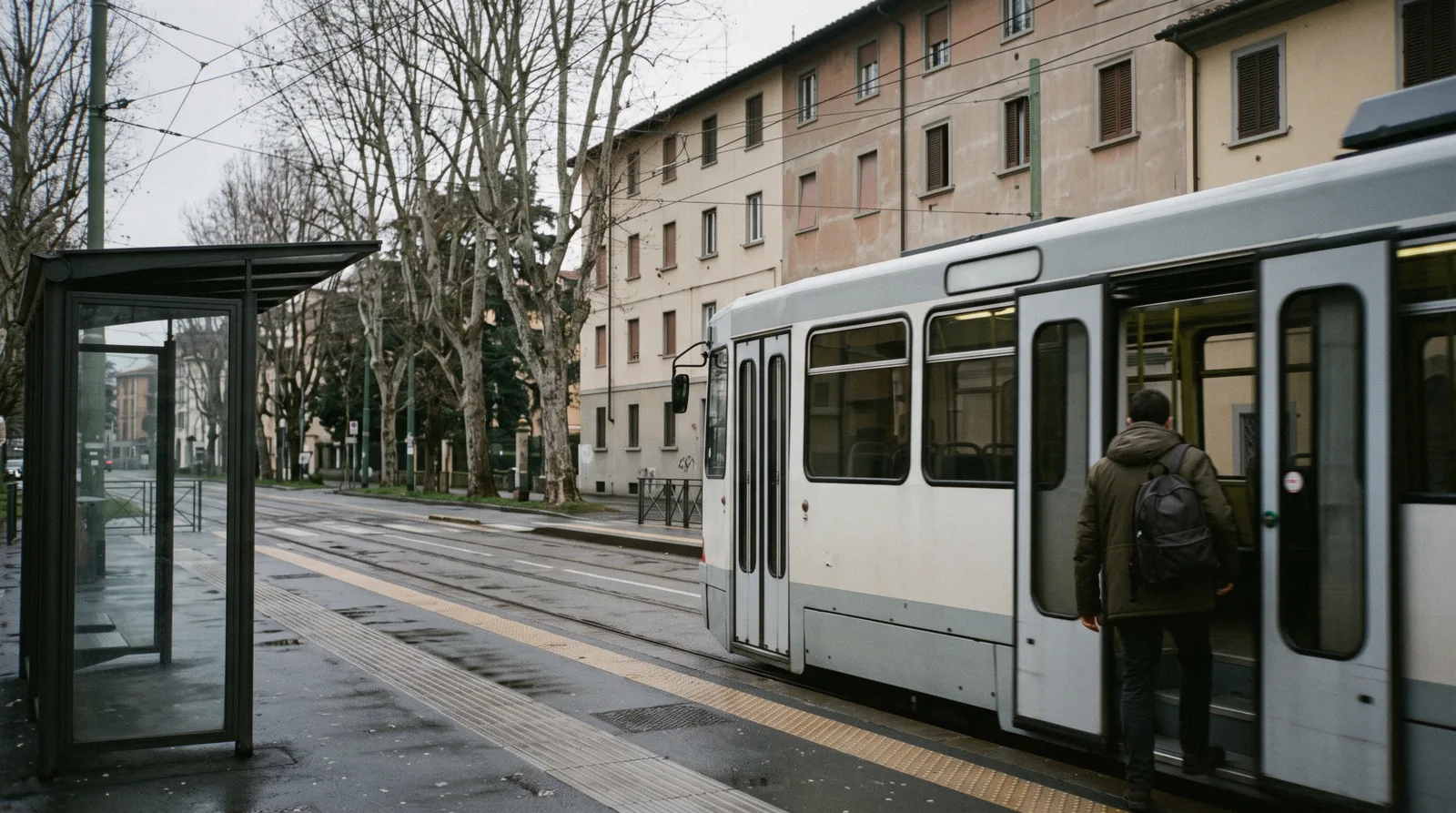
Getting Around Florence
Getting around Florence takes two decisions, not twenty: whether to buy a ticket at all, and what to do with a car. Almost everything in this guide is inside a twenty-five-minute walk of the Duomo, so the average visitor rides twice in a whole stay — the tram in from the airport and a bus up to the viewpoint. The fares below are from the Autolinee Toscane sheet that took effect on 1 August 2026, the tram times are from the operator GEST, and the ZTL hours come from the city's own mobility page. The rest of the trip — the sights, the tickets and the itineraries — sits on our guide to things to see in Florence.
Quick answer Walk it, one ticket, one tram, one warning
Walk. Every sight in this guide sits inside a twenty-five-minute walk of the Duomo, and most visitors buy two tickets in an entire stay. A single ticket costs €2 (about $2.30) and lasts 90 minutes on both city buses and trams, on the Autolinee Toscane fare sheet that took effect on 1 August 2026. The tram from the airport takes the same ticket. The one thing that can cost you real money is a hire car: the camera gates around the centre are on all week.
Key takeaways
- The centre is walkable end to end — Santa Maria Novella station to the Duomo is about 13 minutes, the Duomo to the Uffizi about 9. The rest are in the walking times table.
- One €2 ticket covers 90 minutes on bus and tram; it is €3 (about $3.50) from the driver, and there is no 24-hour or 3-day pass on the 2026 sheet — see what a ticket costs.
- Tram T2 links the airport to the centre in 20 minutes on that ordinary ticket, and bus 12 is the ride up to Piazzale Michelangelo — the two lines a visitor actually uses.
- Arriving by car? Read the ZTL section before you set the satnav. If you would rather nobody drove, a Tuscan day by coach collects you in the centre and gives the car problem back to somebody else.
Do you need public transport at all?
Straight-line distances computed from the GPS coordinates on each venue's own record, then converted to walking minutes at 1.3 times the straight line and 80 metres a minute, which is how the walk times on this site are produced.
| Route | Straight line | On foot | What the walk is like |
|---|---|---|---|
| Santa Maria Novella station → Duomo | 810 m | about 13 minutes | Via de' Panzani then Via de' Cerretani, flat, busy from nine in the morning |
| Station → Accademia | 870 m | about 14 minutes | Allow this on an 8:15 slot day and leave the hotel at ten to eight |
| Duomo → Uffizi | 540 m | about 9 minutes | Straight down Via dei Calzaiuoli, the busiest pavement in the city |
| Duomo → Accademia | 460 m | about 7 minutes | Via Ricasoli, one straight line, no crossings that matter |
| Duomo → Santa Croce | 690 m | about 11 minutes | Through the Bargello block; the last stretch is quiet in the morning |
| Uffizi → Ponte Vecchio | 180 m | about 3 minutes | Along the loggia and out to the river |
| Ponte Vecchio → Pitti Palace | 400 m | about 7 minutes | Over the bridge and up Via de' Guicciardini, narrow pavements |
| Duomo → Mercato Centrale | 500 m | about 8 minutes | Past San Lorenzo and the stalls; the market runs to 23:00 |
| Pitti Palace → Piazzale Michelangelo | 1,240 m | about 20 minutes on the flat | Uphill from Porta San Niccolò — add ten minutes for the climb, or take bus 12 |
| Duomo → Piazzale Michelangelo | 1,310 m | about 21 minutes on the flat | The Rampe del Poggi stairs are the last part; allow half an hour in July |
They are our arithmetic, not an official figure, and the two hill routes are honest only about the flat part — the climb adds to them. Two rides in a stay is the realistic answer for most visits: bus 12 up to the viewpoint, tram T2 out to the airport. If you are staying more than four nights and plan the hill twice, the ten-ride carnet below starts to pay. Figures current in Q3 2026.
Tickets and fares in 2026
One ticket covers both networks: Autolinee Toscane runs the city buses, GEST runs the trams, and the ordinary urban ticket is valid on both inside the Florence urban area. Prices below are from the operator's 2026 fare sheet, in force from 1 August 2026. Dollar figures are approximations at €1 = $1.17.
Buy before you board wherever you can. The driver sells a ticket, but at a mark-up, and the machines at every tram stop take cards.
| Ticket | Price | Approx. USD | Valid for | Where you get it |
|---|---|---|---|---|
| Single urban ticket | €2 | $2.30 | 90 minutes, buses and trams | Operator app, tram-stop machines, tabacchi and sales points |
| Contactless tap on board | €2 | $2.30 | 90 minutes | Card, phone or wearable on the readers inside the vehicle |
| SMS ticket | €2.40 plus the operator's SMS cost | about $2.80 | 90 minutes | Text from an Italian mobile number |
| Bought from the driver on board | €3 | about $3.50 | 90 minutes | On the bus, when nothing else was open |
| Carnet of ten rides | €18.20 | about $21 | Ten journeys of 90 minutes | App and sales points |
| Monthly pass | €42.20 | about $49 | Calendar month | App and sales points |
| Daily, 24-hour or 3-day pass | not stated | — | — | Not on the 2026 fare sheet at all |
That last row answers the question this site gets asked most often. There is no tourist day pass in Florence: the 2026 sheet lists singles, the ten-ride carnet at €18.20, then monthly €42.20, quarterly €104.50 (about $122) and annual €342.80 (about $401), and nothing in between. If you want a multi-ride option for a family, the carnet is it — ten rides at €1.82 each, and one carnet can cover several people on the same trip as long as each of them validates.
The fares are identical on the tram, which matters mainly for the airport: there is no airport surcharge and no separate airport ticket. Ninety minutes is generous for a city this size; the longest ride a visitor takes, the airport tram, uses twenty of them.
How to pay, and what to do when you board
Four channels sell you the same €2 ride. The operator's app sells singles and passes; the machines at every tram stop sell singles only and take cards and contactless; a tabacchi or newsagent with the operator's sticker sells paper tickets over the counter; and the readers inside the tram take a contactless card, a phone or a watch directly. The 2026 fare sheet also lists third-party apps — TABNET, URBI and TELEPASS — as sales channels. The SMS ticket at €2.40 needs an Italian mobile number, which is why it is the one channel most visitors can ignore.
Validate the moment you board. A paper ticket goes into the small machine by the door and comes out stamped with the time; a contactless tap is its own validation. The ninety minutes run from that stamp, not from the purchase, so a ticket bought at the airport on Tuesday and stamped on Thursday is perfectly valid. The fine for travelling without a validated ticket is not stated on the pages we read, so we do not print a figure — assume it is more than the ticket and stamp it.
One bag up to 10 kg and 55 by 40 by 20 centimetres travels free on the tram. A larger case, up to 80 by 45 by 25 centimetres and 20 kg, needs a supplementary ticket and you may carry at most two of them; anything bigger is refused. Pushchairs travel free. There are no luggage racks on the trams, which is worth knowing before the airport run with two suitcases at eight in the morning.
The tram, and the airport link
The trams are run by GEST, part of the RATP Dev group, and the line that matters to a visitor is T2: it runs from Peretola Aeroporto to San Marco – Università, and the operator's own airport page puts the centre twenty minutes from the terminal. The Peretola Aeroporto stop is a two-minute walk from arrivals and departures, and the airport itself is about 5 km from the middle of town. The fare is the ordinary urban ticket — €2, ninety minutes — because no separate airport fare is listed anywhere on the operator's fare page.
Service runs every day from 05:00 to 00:30, and until 02:00 on Friday and Saturday nights. From the airport towards San Marco the first tram is at 05:00 daily and the last at 23:58 Sunday to Thursday, 01:15 on Friday and Saturday. In the other direction, towards the airport, the first is also 05:00 and the last leaves at 00:30 Sunday to Thursday, 02:00 on Friday and Saturday. For a 06:30 flight that means the tram does not help you and the taxi does; for anything after about 07:30 it does.
The network also has a line T1, and the operator names T1 and T2 as its lines — but the page listing termini and stops renders its content in JavaScript and gave up nothing readable, so we do not print T1's route here rather than copy it from a blog. What we can say is that the tram skirts the historic centre on its west side: it is the way in from the airport and from the western suburbs, and it is no use at all for moving between the Duomo, the Uffizi and Santa Croce, which is what the walking times table is for.
The full arrival playbook — first and last trams, night taxis and the route in from Pisa's airport — is on Florence airport to the city center.
When the tram is the wrong tool
- Moving between sights in the centre — the walk is shorter than the wait.
- A flight before about 07:30, when the first tram at 05:00 still lands you at the terminal too late for a comfortable check-in on a long queue day.
- Two large suitcases at rush hour: the rules allow them with a supplement, but there are no racks and nowhere to put them.
The bus a visitor actually uses: line 12
Bus 12 climbs from Santa Maria Novella station to Piazzale Michelangelo, and it is the single most useful bus in the city for a visitor: the abbey of San Miniato al Monte names it on its own contact page as the way up, with the stairs from the Piazzale for the last stretch. Buy the €2 ticket before you get on, because the driver charges €3.
The walk up is about twenty-one minutes from the Duomo on the flat plus the Rampe del Poggi stairs, so the honest advice is to ride up and walk down: you get the view without the climb, and the descent through the Rampe gardens into Piazza Poggi is the better half of the walk anyway. If you are going for sunset, ride up before the light goes and take the stairs down afterwards while the terrace is still emptying. The judgement about which approach suits which visitor, and where to stand on the terrace, sits on the viewpoint's own page.
Other lines exist — bus 7 to Fiesole from Piazza San Marco is the other one visitors ask about — but the route numbers repeated across travel blogs for the hill are not all confirmed on an official page, and we print only the ones that are. Hop-on hop-off buses and private shuttles are not covered by the operator's fare sheet and are not covered here. On a strike day none of this is a given: bus and tram stoppages are published days ahead and run to protected hours, which is what still runs during a Florence transport strike.
Taxis: what the meter starts at
Florence taxis are metered on a tariff table published by the Comune di Firenze. The most recent published table dates from 2024, so treat these as 2024 figures that have not been superseded in public rather than as a 2026 price list, and check the meter.
Taxis do not cruise for fares here: you find them at a rank — the station, Piazza della Repubblica, Piazza Santa Croce — or you call one, and the meter starts when the car sets off to collect you.
| Charge | Weekday | Sunday and holidays | Night 22:00–06:00 |
|---|---|---|---|
| Meter start | €3.60 (about $4.20) | €5.80 (about $6.80) | €7.30 (about $8.50) |
| Minimum fare | €5.50 (about $6.40) | €7.70 (about $9) | €9.20 (about $11) |
| Shared 'taxi multiplo', per person | €5.50 (about $6.40) | €6.60 (about $7.70) | €6.60 (about $7.70) |
| Each piece of luggage | €1.10 (about $1.30) | €1.10 | €1.10 |
On top of the start, the meter runs at €1.00 a kilometre in the two urban bands and €1.99 a kilometre in the third, in eleven-cent steps, and it switches to a waiting rate of €28.60 an hour in band one when the traffic drops the car below about 27 km/h. Out-of-town runs are all charged at €1.99 a kilometre with motorway tolls added and paid by the passenger. The 'taxi multiplo' rate needs at least three people going to the same zone and is the one genuinely cheap way to take a taxi here.
The airport fare is where the internet is confidently wrong. A fixed price for the run between Peretola and the centre circulates widely; it is not on the Comune tariff table we read, so we do not publish it as official. Assume a metered fare on the figures above, or take the T2 tram for €2 and spend the difference on dinner.
Driving in: the ZTL is the expensive mistake
The historic centre is a limited-traffic zone. Camera gates read every plate that crosses the line, and they are live Monday to Friday 7:30–20:00 and Saturday 7:30–16:00, off on Sundays and public holidays. From the first Thursday of April to the first Sunday of October a summer night ZTL is added on top: Thursday to Saturday, 23:00–03:00. There is no ticket to buy at the gate and no barrier to stop you — the first you hear of it is a letter, often months later, forwarded by the hire company with its own administration fee attached.
If your hotel is inside the zone, it can register you: give reception or the garage your plate the moment you arrive, and they transmit it to the Municipal Police. Do this on arrival, not at checkout. The fine amount is not stated on the city's own page; enquiries go to firenze@myfines.it or +39 055 0353400, which is a sentence worth keeping in a screenshot if a letter ever turns up.
The alternative is simple: leave the car at one of the Parcheggi Scambiatori, the park-and-ride sites on the edge of the city, and come in on the tram or a bus. Tourist coaches have their own regime — a ZTL Bus that covers the whole municipality 24 hours a day — which is why an organised day trip picks you up where it does rather than outside your hotel door. The garages and their prices are in parking in Florence. If parking is going to shape your booking, the neighbourhood guide is the page that maps which areas sit outside the gates.
Parking in Florence: garages and the park-and-ride
Parking in Florence is a question of where the car stops, not how close to the Duomo it gets. The camera gates in the ZTL section close the historic centre, so the real choice is a public garage on the ring of avenues around it or a park-and-ride on the edge of the city with the tram for the last stretch.
The six car parks below are the ones a visitor driving in is most likely to use. Prices are the standard car tariffs printed on each operator's own page: Firenze Parcheggi for the city garages and Parcheggio Villa Costanza for the motorway park-and-ride.
| Garage | Where | Price | For |
|---|---|---|---|
| Villa Costanza | On the A1 motorway, entered only from the motorway | First 15 minutes free, €2 (about $2.30) for 1-4 hours, €5 (about $5.90) for 4-10 hours, €7 (about $8.20) up to 24 hours | A day in town. T1 tram to the station in 22 minutes |
| Porta al Prato Leopolda | Via Gabbuggiani 2/4, by the Maggio Musicale theatre | €2 (about $2.30) an hour, €20 (about $23.40) a day | Parking beside the T1 tram line |
| Stazione Fortezza Fiera | Under the Fortezza da Basso, Piazzale Caduti nei Lager | €2 (about $2.30) an hour, €20 (about $23.40) a day | Trade fairs, and a walk to the station |
| Parterre | Via del Ponte Rosso 4, by Piazza della Libertà | €2 (about $2.30) an hour, €15 (about $17.60) a day | The cheapest full day in a city garage |
| Beccaria | Viale Amendola 7, under Piazza Beccaria | €2 (about $2.30) an hour, no day rate | Short stops on the east side |
| Stazione S.M.N. | Piazza della Stazione 13, at the station | €4 (about $4.70) an hour, no day rate | Dropping off or collecting at the train |
Two things decide the bill. A day rate caps it: €15 at Parterre, €20 at Fortezza Fiera and Porta al Prato. Beccaria and the station garage have none, so eight hours at the station costs €32 (about $37.40). Villa Costanza beats all of them for a day in town. €5 covers 4 to 10 hours, and even with a €2 tram ticket each way for two people the total stays under the cheapest city garage. None of the Firenze Parcheggi garages take bookings, and their height limits run from 2.00 to 2.05 metres, which rules out most camper vans. The two market garages, Sant'Ambrogio and San Lorenzo, are priced for shoppers: San Lorenzo charges €8 (about $9.40) for every hour from the third on weekday mornings.
On the street, the colour of the lines tells you who may stop there. The Comune's parking and ZCS page sets it out. Blue lines are paid for visitors: some are mixed bays that are free for residents, others are short-stay rotation bays. White lines are reserved for residents, so white does not mean free in Florence. Yellow lines are for disabled permit holders. For a blue bay, pay at the meter or by app and read the sign on the post for its hours. If you are sleeping in the city, the neighbourhood guide shows which areas sit outside the gates.
Left luggage, and the gap between check-out and the train
Firenze Santa Maria Novella has a KiPoint left-luggage office on the ground floor inside the station, open 07:00–21:00. The station's own service page routes the price to the operator's website and states no figure, so we do not print one — ask at the counter or check before you commit to a plan that depends on it.
Two museums make their own arrangements, and both catch people out. The Accademia has no cloakroom at all: large bags, backpacks and helmets are refused at the door, bottles are limited to half a litre, and the nearest storage is the MyAccademia store outside. The Duomo complex sends luggage to a storage point at Piazza del Duomo 38/r before you climb anything. A guided walk can also solve it — the highlights walking tour at €17 lists free luggage storage among its inclusions, which on an arrival morning is worth more than the tour.
The practical shape of a last day: check out, walk the bags to the station, leave them at KiPoint, spend the afternoon at the Bargello or in the Oltrarno, collect at seven, and take the tram or the train. Nothing in that sequence needs a taxi.
Leaving the city: trains and the regional bus
Every day trip in this guide starts at Firenze Santa Maria Novella. Regional fares inside Tuscany are not route prices at all — Trenitalia charges by distance band under the regional tariff for Tuscany that took effect on 1 August 2026, so the fare depends on how many kilometres you cover, not on which town you choose.
The bands below are the second-class adult fares from that tariff. We could not source the kilometre band for Florence to Pisa, Lucca, Siena or La Spezia from an official page. Trenitalia publishes no route fare list and its booking service refused automated queries, so we quote the table rather than invent a single-route price.
Check the fare live when you buy.
| Distance band | 2nd class adult | Approx. USD |
|---|---|---|
| 1–10 km | €1.70 | about $2 |
| 21–30 km | €4.10 | about $4.80 |
| 41–50 km | €6.60 | about $7.70 |
| 71–80 km | €8.90 | about $10.40 |
| 91–100 km | €10.80 | about $12.60 |
| 141–150 km | €15.10 | about $17.70 |
Two rules save money and confusion. Children aged 4 to under 12 pay 50% of the adult fare on regional trains, so the 71–80 km band costs a child €4.50 rather than €8.90. And every station in the Florence node — Santa Maria Novella, Campo di Marte, Rifredi, Statuto, Le Cure, Castello, Rovezzano, San Marco Vecchio, Le Piagge — is ticketed simply as 'Firenze': the fare is measured from Santa Maria Novella and the ticket lets you start or finish at any of them, which is useful if your hotel is closer to Campo di Marte. Trenitalia's TAP&TAP channel also sells a single at the standard regional fare straight from a contactless card at the departure station.
For Siena, where the bus beats the train because the station sits below the town, Autolinee Toscane's fast-route fares also run on distance bands: band 8, which covers 70–80 km, is €10.90 (about $12.80) bought in advance and €16 (about $19) on board. We have not been able to verify from an official page that the Florence–Siena route is assigned to band 8, so treat it as the likely band and check at the counter. The route-by-route comparison of train, bus and coach for each destination lives on every day trip compared with the train.
Florence bus station: where coaches actually stop
Florence has no single bus station. Long-distance coaches and regional buses use different stops, and the stop printed on your ticket is the one that counts, not the city name.
Many coaches from other Italian cities and from abroad stop at Villa Costanza, the terminal on the A1 motorway that calls itself Florence's bus station. It has a ticket desk for the tram and every coach company that uses it, free toilets and free wifi. The T1 tram leaves from the same site and reaches Santa Maria Novella in 22 minutes on the ordinary €2 ticket (about $2.30). FlixBus's own stop list for Florence also names Piazzale Montelungo by the Fortezza da Basso, a stop at Santa Maria Novella station and Guidoni on the T2 airport tram. Itabus lists Villa Costanza, Piazzale Montelungo and Guidoni. FlixBus tells passengers on interconnection tickets to get off at Villa Costanza, and when Piazzale Montelungo is closed it moves that stop to Via Edoardo Detti, reached on the T1 from the Nenni-Torregalli stop.
For regional buses run by Autolinee Toscane, start at the operator's Florence ticket office at Via Santa Caterina da Siena 17, a couple of minutes' walk from Santa Maria Novella station. It opens 06:05-20:15 on weekdays and 06:45-20:00 on public holidays, and closes on 1 January, Easter, 1 May, 15 August and 25 December. This is where you buy a paper ticket for Siena and ask which stand your bus leaves from.
Inside the city, every Florence city bus takes the same €2 ticket, valid 90 minutes across buses and trams. The route list sits on Autolinee Toscane's Florence lines and timetables, bus 12 is the one most visitors need, and how to pay covers tapping in on board.
Steps, ramps and what the official pages actually promise
Florence is flat inside the walls and paved in stone that is uneven almost everywhere, and the honest position is that most of what a visitor wants to know about step-free access is not published. What is published is worth knowing before you plan a route.
Orsanmichele states plainly on its own page that it has no disabled access and no restrooms. The Uffizi's accessible way in is the ramp on Via della Ninna rather than the main courtyard door, and the Accademia's accessible entrance is Via Ricasoli 60, next to the standard one at 58. Boboli has four entrances — Pitti, Via Romana, Forte di Belvedere and Porta Romana — and the gradient between the palace and the top of the garden is the reason to care which one you use. The Dome and the Bell Tower have 463 and 414 steps respectively and no lift of any kind, which is a fact, not a caveat.
On the transport side: pushchairs travel free on the tram, trams are level with the platform at their stops, and the Rampe del Poggi is a staircase, so bus 12 is the step-free way to the Piazzale. Stroller and wheelchair admission rules inside individual museums are not stated on the pages we fetched, and we would rather write that than guess at a lift that may not exist. If a specific venue matters to your trip, its own accessibility desk is the only source worth trusting.
When paying somebody else to handle the logistics wins
Four cards for the two moments transport becomes the problem: the first morning, when you do not yet know which way the Duomo is, and the day you want Tuscany without a hire car and a ZTL letter. Prices and ratings are the platform's own figures.
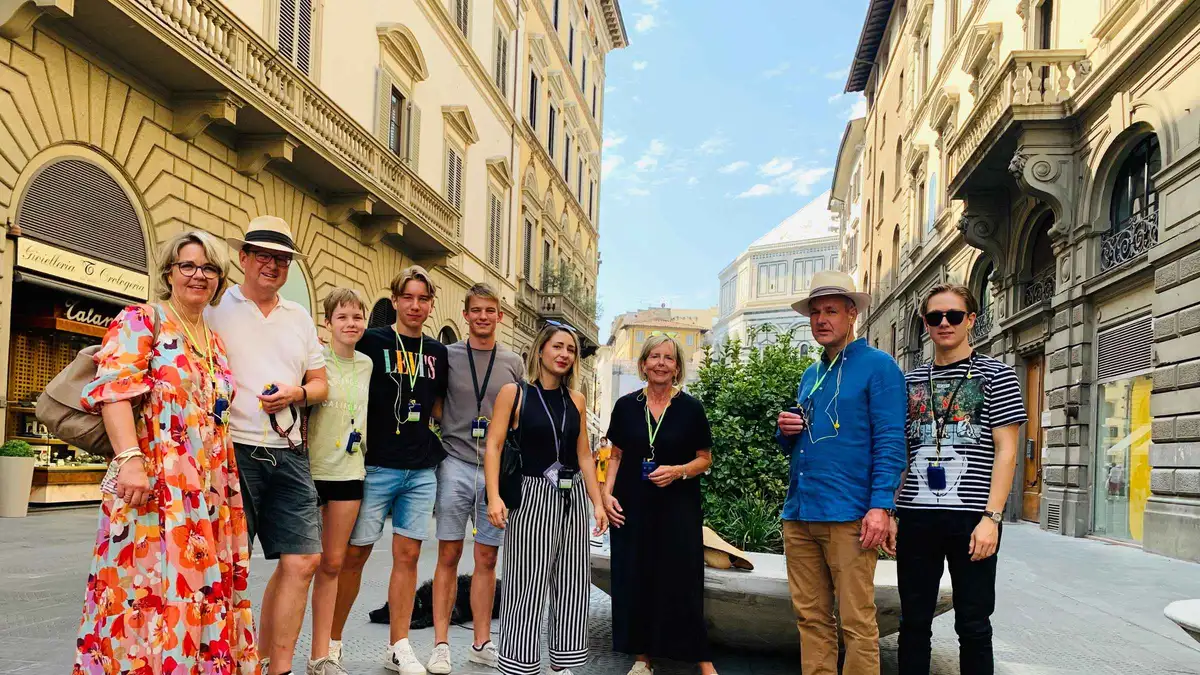 from €17
Florence: Highlights Walking Tour with Expert Guide
listed at $20.27
90-minute small-group highlights walk (Duomo, Piazza della Signoria, Ponte Vecchio) in 8 languages, with free luggage storage. Runs rain or shine.
Check Availability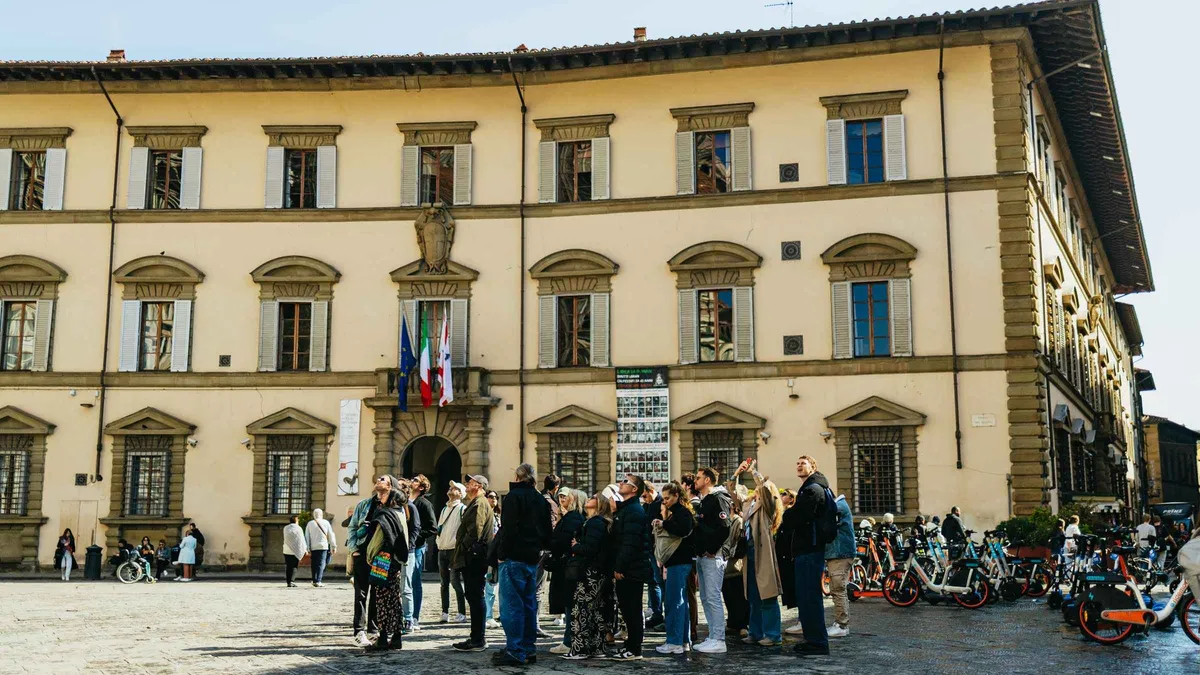 from €12
Top rated
from €12
Top rated
Florence: Renaissance and Medici Tales Guided Walking Tour
listed at $13.90
Two-hour storytelling walk on the Medici and the Renaissance in English or Spanish, ending with local eating and shopping tips. Cheapest tour here.
Check Availability from €49
Best seller
from €49
Best seller
Florence: Pisa, Siena and San Gimignano Day Trip with Lunch
listed at $56.76
12-hour coach day to Pisa, Siena and San Gimignano with a winery lunch; guided Siena walk and cathedral only on the English option. Eight languages.
Check Availability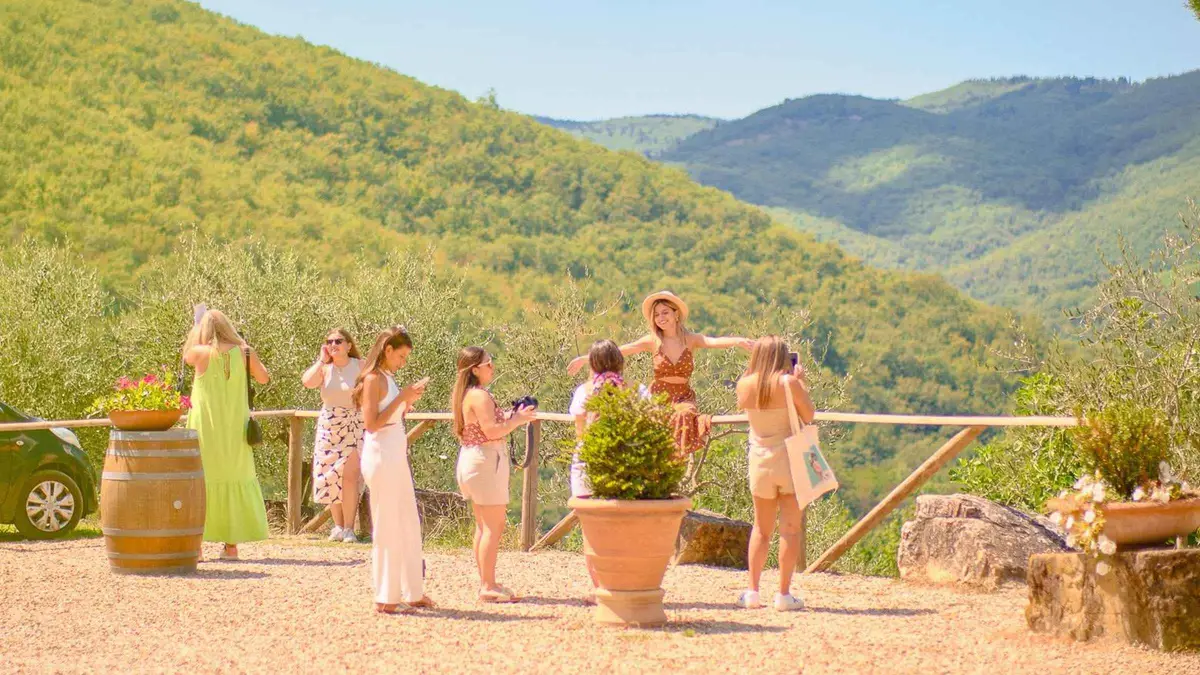 from €49
Best seller
from €49
Best seller
Florence: Chianti Wineries Tour with Wine Tasting
listed at $57.34
Half-day coach trip to two Chianti wineries with 3–4 wines at each plus bread, oil and salami; English or Italian, small-group dinner option. No lunch.
Check AvailabilityPrices, ratings and details are the platform's own. Dollar figures are the listed prices. The platform bills in your account's currency.
The two lines and the six points they connect
Green pins are the two transport nodes — the airport tram terminus and Santa Maria Novella station. Terracotta pins are the places the walking table measures between. No tram route line is drawn, because no official route geometry was available to copy.
The other money you hand over on arrival
Two charges surprise people, and neither is transport. The city tourist tax is collected by your accommodation, per person per night, for up to seven consecutive nights: €3.50 (about $4) at a one-star hotel or campsite up to €8 (about $9) at five stars, with €6 (about $7) covering B&Bs, holiday flats and three-star hotels. Children under 12 are exempt. The figures are the 2025 table, which the city's tourism site still published as current when we read it; the full grid by category sits on where to stay.
The Firenzecard is the other one. It costs €85 (about $99) and runs 72 hours from your first museum entry, and it does not include public transport of any kind — no bus, no tram, no airport ride. It also leaves out the Duomo complex. Whether it pays at all depends on how many museums you can physically get through in three days, which is the arithmetic on the card's own page.
Where to go next
A day that needs no ticket at all
The one-day route is walkable from first slot to sunset: a one-day plan that is all on foot.
All inside 25 minutes' walkOut of the city by train
Pisa, Siena, Lucca, Bologna and the Cinque Terre, each with the train option weighed against the coach: every day trip compared with the train.
Fares by distance bandThe card that skips transport
What €85 buys in 72 hours, and the museums it leaves out: the museum card that excludes buses. Or start again at the best things to do in Florence.
72 hours, no transportGetting around Florence: questions
Is the bus free in Florence?
No. A single urban ticket costs €2 (about $2.30) and is valid 90 minutes on city buses and trams; from the driver it is €3. The full list of channels and prices is in tickets and fares.
Can I pay for the tram with a card?
Yes. The machines at every tram stop take cards for singles, and the readers inside the tram accept a contactless card, phone or wearable directly at €2. See how to pay.
Is there a 24-hour or 3-day travel pass in Florence?
Not on the 2026 fare sheet. The multi-ride option is the carnet of ten rides at €18.20 (about $21); after that the sheet jumps straight to a monthly pass at €42.20. The whole table is in tickets and fares.
How do I get from Florence airport to the city centre?
Tram T2 from the Peretola Aeroporto stop, two minutes' walk from arrivals, into the centre in 20 minutes on the ordinary €2 ticket. First tram 05:00 daily, last 23:58 Sunday to Thursday and 01:15 on Friday and Saturday — details in the tram section.
Which bus goes up to the viewpoint over the city?
Bus 12 from Santa Maria Novella station, which the abbey of San Miniato names on its own page as the way up. Ride up, walk down the Rampe del Poggi stairs — the reasoning is in the bus section and on the viewpoint's page.
What happens if I drive into the Florence ZTL?
A camera photographs the plate and a fine follows, usually via the hire company. The gates run Monday to Friday 7:30–20:00, Saturday 7:30–16:00, plus Thursday to Saturday 23:00–03:00 in summer. A hotel inside the zone can register your plate if you hand it over on arrival — see the ZTL section.
Where can I park in Florence?
In a garage on the ring of avenues or at the Villa Costanza park-and-ride on the A1, not on the street inside the ZTL. Parterre charges €15 (about $17.60) for the day, and Villa Costanza €7 (about $8.20) for up to 24 hours with the T1 tram to the station in 22 minutes. The six garages are compared in parking in Florence.
Where is the bus station in Florence?
There are several stops. Long-distance coaches use Villa Costanza on the A1, 22 minutes from Santa Maria Novella on the T1 tram, and Piazzale Montelungo by the Fortezza da Basso. Autolinee Toscane's regional ticket office is at Via Santa Caterina da Siena 17, near the station. The details are in where coaches stop.
Is public transport included in the 72-hour museum card?
No. The €85 card covers museums for 72 hours and excludes public transport entirely, as well as the Duomo complex. The arithmetic on whether it pays is on the card's page.
Where can I leave luggage near Santa Maria Novella station?
The KiPoint office on the station's ground floor, open 07:00–21:00; the price is not stated on the station's service page. Museum-side alternatives, including the walking tour that stores bags free, are in left luggage.
How do tourists get around Florence?
On foot, mostly. Every sight in this guide sits inside a twenty-five-minute walk of the Duomo, so most visitors ride twice in a stay: tram T2 in from the airport and a bus up to Piazzale Michelangelo or Fiesole. A single ticket costs €2 (about $2.30) and runs 90 minutes on buses and trams.
Getting Around Florence on Video
Three clips that show what the fare machines, the tram platforms and the pavements actually look like before you land.
Getting around in Florence: a transportation guide
A walk-through of the city's buses, trams and on-foot routes from a Florence study-abroad channel.
Video: LdM NEWSGetting around Florence
Short field guide to boarding, validating and the distances between the main sights.
Video: LdM NEWS43 Tips I Wish I Knew Before Visiting Florence, Italy
Includes the ticket, ZTL and airport-transfer mistakes first-time visitors make.
Video: Camden DavidVideos load from YouTube only when you press play.
Prices, hours and terms are set by the venue or operator and confirmed at checkout.
We may earn a commission if you book through one of our links, at no extra cost to you. Full affiliate disclosure