 Florence City Guide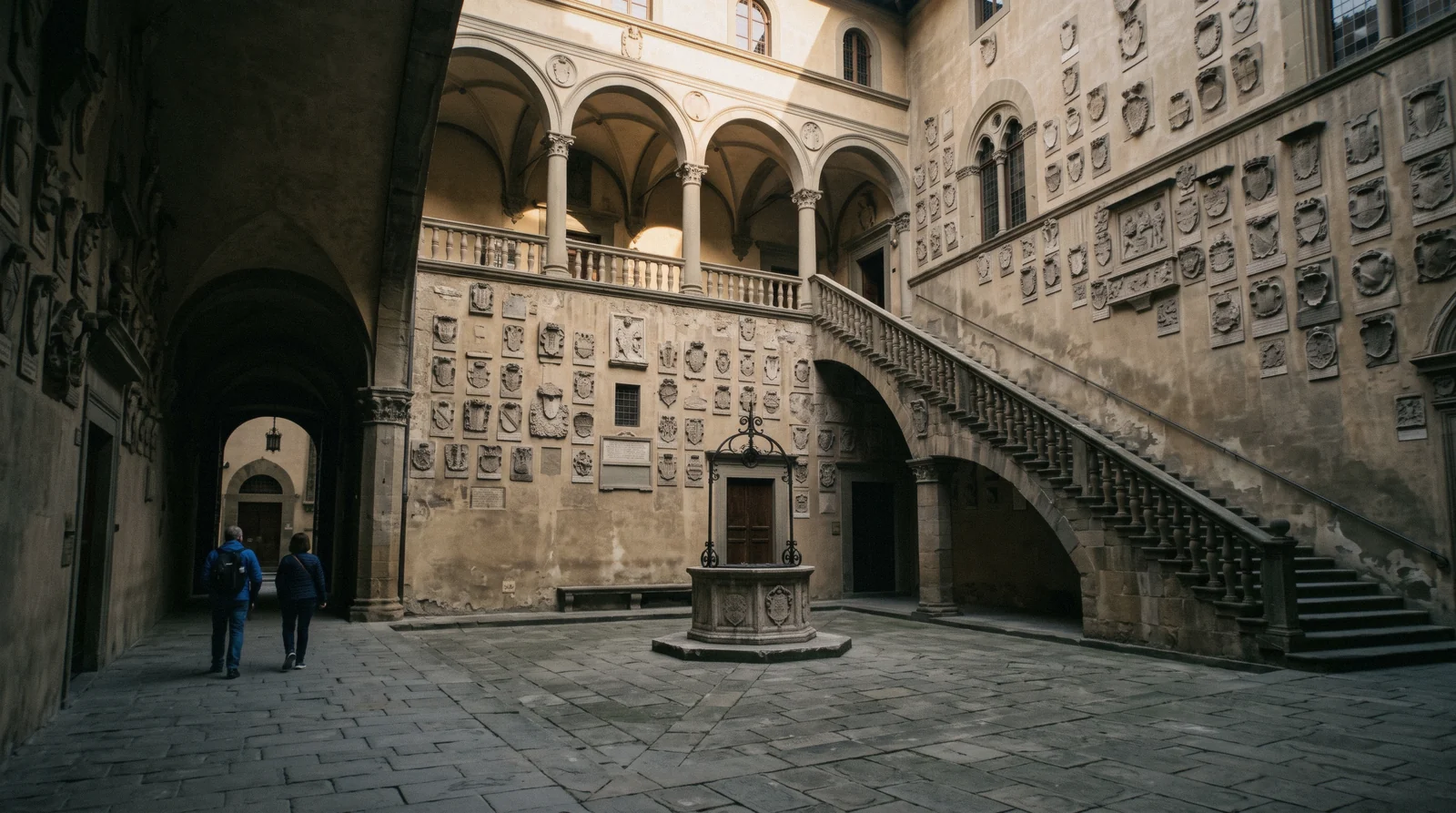
Bargello Museum
The Bargello Museum — Museo Nazionale del Bargello, pronounced bar-JEL-lo after the chief of police who once sat here — is the sculpture museum on Via del Proconsolo, five minutes from the Uffizi and three from Piazza della Signoria. It holds Donatello's bronze David, Michelangelo's Bacchus and the two panels that decided the 1401 Baptistery doors competition, and on most mornings you walk straight in. This page has the hours, the prices, the works worth finding and the combined ticket that changes the maths for anyone also going to see Michelangelo's David at the Accademia. Every hour and price here comes from the museum's own pages, as everywhere else in this guide to what to see in Florence.
Quick answer Price, hours, the works, how long — in three lines
A reserved-entry ticket to the Bargello costs €19 (about $22). The museum opens Tuesday to Sunday 08:15–18:50 and closes on Mondays. Individuals do not need to book, so the ticket is about fixing your hour.
Key takeaways
- Donatello's bronze David, Michelangelo's Bacchus and the two 1401 Sacrifice of Isaac panels by Ghiberti and Brunelleschi are why people come; allow about 1.5 hours — the museum states no visit length, that estimate is ours
- If you want a fixed time rather than a walk-up, a reserved-entry Bargello ticket carries a binding slot and an audio app, which is worth it only when the rest of your day is already timed
- The 48-hour ticket with the Accademia is €26 (about $30) — less than the two bought apart, so the combined-ticket rules are the first thing to read if David is also on your list, and the Medici Chapels join the same family on the 72-hour ticket
Key facts
Opening hours
| Tuesday–Sunday, all year | 08:15–18:50 |
|---|
Closed Mondays
Admission
- Adult
- €19 reserved entry with audio app (about $22) or €18 skip-the-line (about $21). €26 for 48 hours with the Accademia (about $30) and €38 for 72 hours across six museums (about $44), both sold by the museum
- Reduced
- Reduced 'per current regulations' — the museum page prints no figure, so do not budget one
- Free
- Under 18; first Sunday of each month; 25 April; 4 November. Reservation is mandatory only for school groups and groups over 8
Planning it
- Time needed
- Not stated by the museum; our routing: about 1.5 hours for the ground floor, the loggia and the Donatello room
- Book ahead
- Optional — walk-up usually fine
- Address
- Via del Proconsolo 4, 50122 Firenze
Two ways into the Bargello from the cards on this page: a reserved-entry ticket with an audio app and a skip-the-line ticket, at the prices GetYourGuide and Tiqets list.
There is rarely a queue here, so the real question is whether you want an audio app with your slot.
| Option | Price | Includes | Cancel | Book |
|---|---|---|---|---|
| Reserved-entry ticket with audio appVisitors who want a fixed hour and an audio guide on their phone | €19 (about $22) | Binding time slot, digital audio guide of Florence | Free up to 24 hours before | Check Availability |
| Skip-the-line ticket, TiqetsVisitors who want the slot held with the booking fee already inside the price | €18 (about $21) | Museum entry, temporary exhibition, booking fee | Free to 23:59 the day before | Check Availability |
Both tickets open the same door on Via del Proconsolo, so pick by what you want with it: the audio app, or the Tiqets ticket with its booking fee inside the price. If you are also seeing the Accademia, the museum sells a 48-hour ticket for both at €26 (about $30) and a 72-hour ticket for six museums at €38 (about $44). Casa Martelli is closed until 31 December 2026, so the 72-hour ticket currently opens five doors, not six. Figures current in Q3 2026.
Bargello entry compared
Two entry tickets cover this museum on the platforms we track, one on GetYourGuide and one on Tiqets. Each card links to the seller's own page, where the calendar shows the slots still open.
 from €19
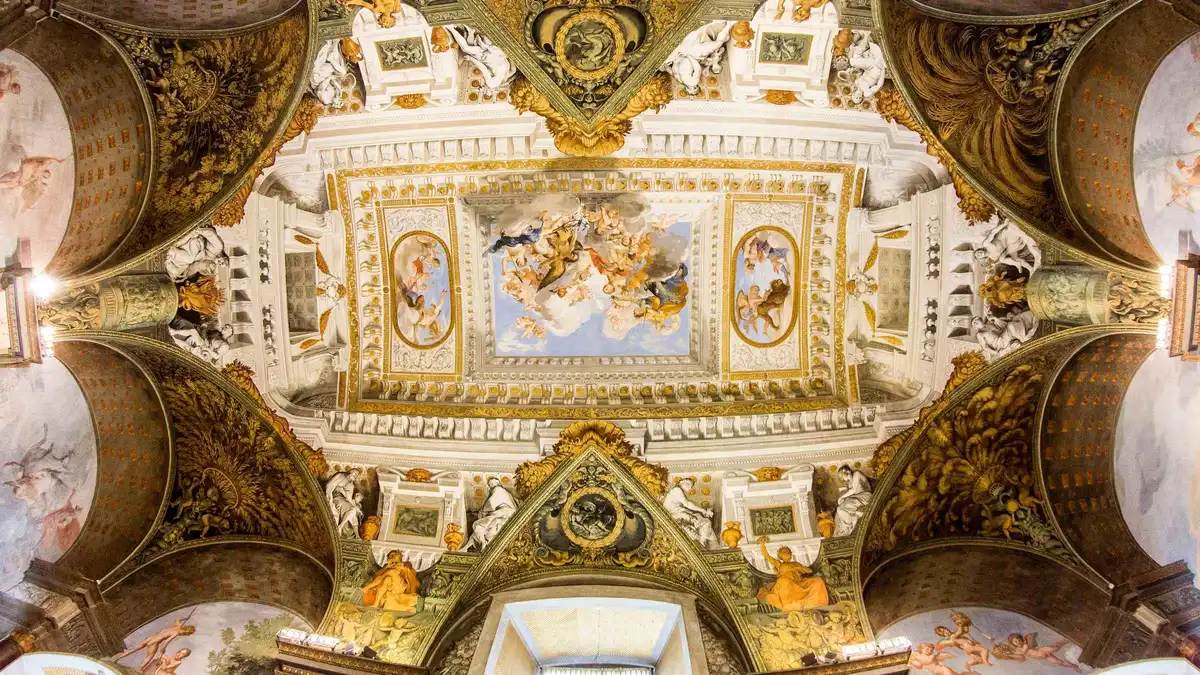
Florence: Reserved Entry Ticket to Bargello Museum
listed at $21.72
Reserved timed Bargello ticket that covers the temporary exhibitions, with a Florence audio app for Donatello's David and the Michelangelo room.
Check Availability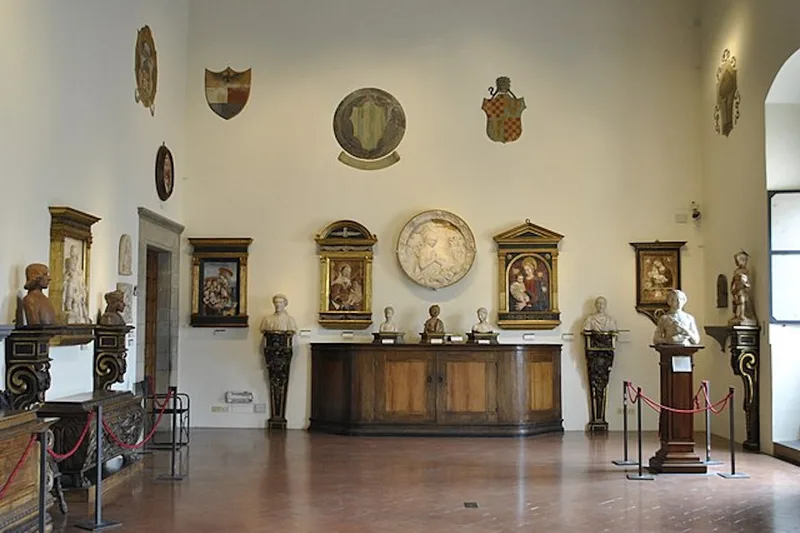 from €18.00
Museo Nazionale del Bargello: Skip The Line Ticket
Bargello skip-the-line ticket at €18 with the booking fee inside it, cancellable to 23:59 the night before. Temporary exhibition included; you show the phone at the ticket office indoors.
Check AvailabilityPrices, ratings and details are the platform's own. Dollar figures are the listed prices. The platform bills in your account's currency.
What the Bargello is: from police headquarters to sculpture museum
The building is older than almost everything it contains. It was a seat of government, then a prison, and only became a museum when the prisoners were moved out in the nineteenth century — which is why the rooms are shaped like nothing else in Florence.
1255: built for the Capitano del Popolo, then the podestà
Construction began in 1255 as the palace of the Capitano del Popolo, the official who represented the guilds against the old noble families. From 1261 it housed the podestà, the chief magistrate brought in from another city so that no Florentine faction could own him. That is the origin of the courtyard: the coats of arms plastered over the walls belong to the magistrates who served their six-month terms and left their crest behind. Nobody scrubbed them off, so you are looking at a stone filing cabinet of Florentine administration.
The tower, the Volognana, went up with the first phase. Look at it from Via del Proconsolo and the building reads as what it was — a fortified office of state, four years older than the first stone of the cathedral.
Prison, police seat and executions in the courtyard until 1786
From the sixteenth century the palace was the seat of the bargello, the police chief whose title the building took — the pronunciation is bar-JEL-lo, with a soft central G, and the word names the office, never a family. It served as prison and police headquarters, and the courtyard was where sentences were carried out until Grand Duke Peter Leopold abolished the death penalty in Tuscany in 1786 — the first state in Europe to do it. The prison stayed until 1859.
This is the part of the story the sculpture makes you forget. You cross a courtyard of executions to reach a room of Renaissance bronzes, and the museum does not dramatise the join at all.
Restored from 1858, opened as the national museum in 1865
Restoration began in 1858 and the Museo Nazionale opened in 1865, the year Florence became the capital of the new Kingdom of Italy. The collection was assembled from the Medici and Lorraine holdings and from suppressed convents: sculpture, bronzes, ivories, arms, ceramics — the material the Uffizi did not display.
Since 2025 the museum has been administered as part of the Galleria dell'Accademia di Firenze e Musei del Bargello, which is why the Accademia and the Bargello now share a ticket office online and why the combined tickets in the table above exist at all.
What to see: Donatello, Michelangelo and the 1401 panels
The collection is arranged around the courtyard and the two floors above it. The museum publishes no official floor plan we could fetch, so the sections below name works and rooms rather than numbers; a plan is handed out at the desk. If you have one hour, do the ground-floor Michelangelo room, the first-floor Donatello room and the panels, in that order.
Michelangelo on the ground floor: Bacchus, the Pitti Tondo, Brutus and the David-Apollo
The room off the courtyard holds four Michelangelos, and they are early, unfinished and strange in ways the David is not. The Bacchus of 1496–97, carved when he was in his early twenties, stands unsteady with a satyr eating grapes behind his leg; it was made for a Roman banker who refused it. The Pitti Tondo of 1503–04 is a marble roundel of the Virgin and Child left deliberately rough at the edges. The Brutus, a bust of about 1540, was carved as a republican gesture after the murder of Duke Alessandro de' Medici and never finished. The David-Apollo is the fourth, and nobody agrees which of the two it is meant to be — the attribute in the figure's hand was never carved.
Giambologna's Mercury, poised on a puff of wind, is in the same part of the building along with his Florence Triumphant over Pisa. Between them, Cellini's bronzes and models for the Perseus round out the sixteenth century before you go upstairs.
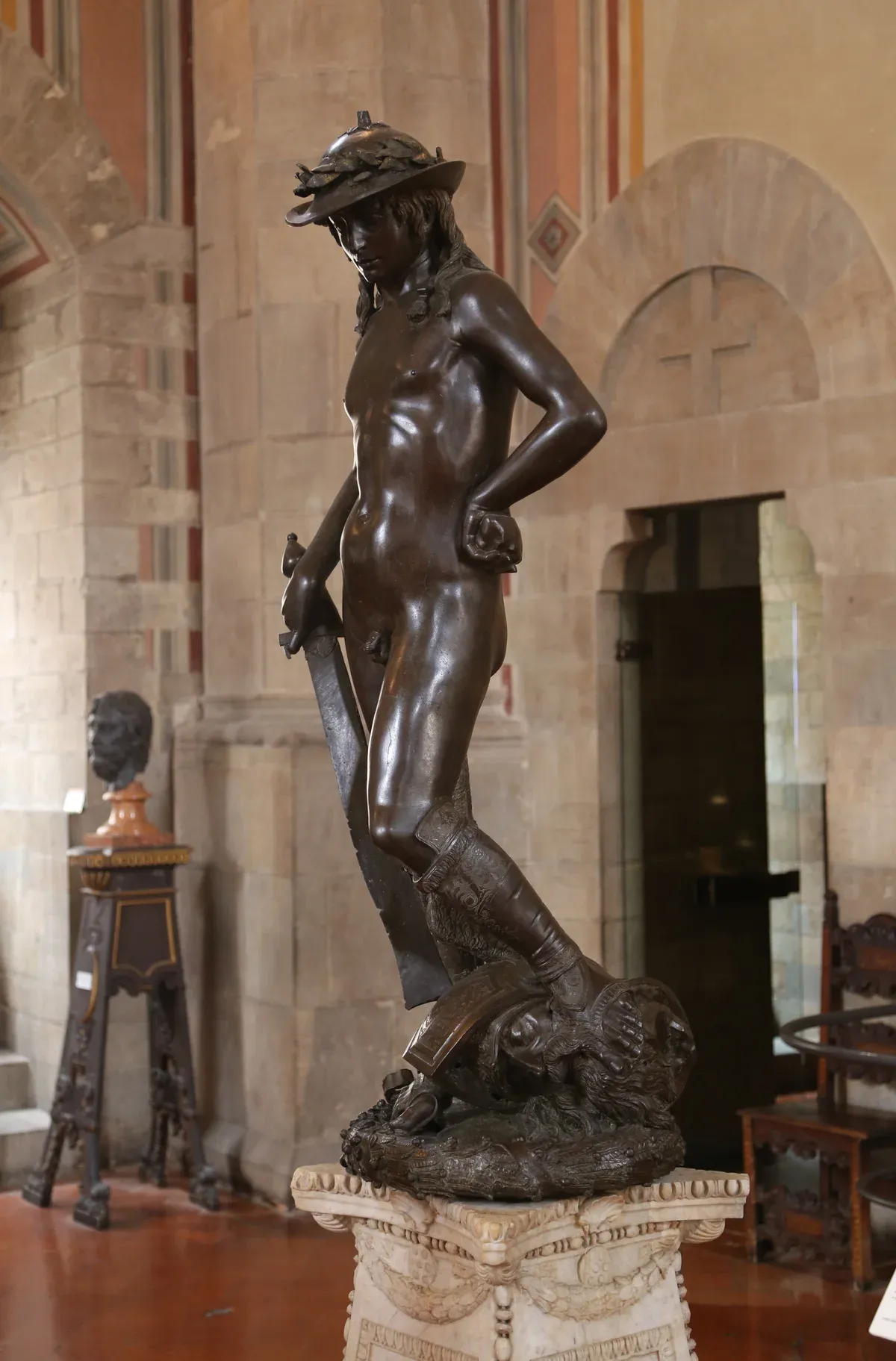
Photo: Rufus46, CC BY-SA 3.0, via Wikimedia Commons (https://creativecommons.org/licenses/by-sa/3.0)
Donatello's bronze David — and his marble one, in the same room
The first-floor Donatello room is the reason this museum matters. The bronze David of the 1440s is the first free-standing male nude cast since antiquity: a boy in a shepherd's hat and boots, standing on the head of Goliath, at a scale that surprises everyone — it is far smaller than photographs suggest. His earlier marble David of 1408–09 stands in the same room, clothed and conventional, and the thirty years between the two is the whole argument of the early Renaissance in one glance.
The Saint George carved for Orsanmichele is here too, moved indoors for its own protection with a copy left in the street-level niche, and so is the Marzocco, the lion holding the Florentine lily that stood on the ringhiera of Palazzo Vecchio. Neither of the two Davids in this building is Michelangelo's; that one is a twelve-minute walk north at the Accademia.
The Sacrifice of Isaac: Ghiberti against Brunelleschi, 1401
Two gilded bronze panels hang side by side on the same wall: the trial pieces Lorenzo Ghiberti and Filippo Brunelleschi submitted for the competition to make the second set of Baptistery doors in 1401. Both show the Sacrifice of Isaac in the same quatrefoil frame, and you can see the two men solving the same brief in opposite ways — Ghiberti's a single flowing composition cast in one piece, Brunelleschi's a violent assembly of separately cast parts. Ghiberti won and spent twenty-one years on the doors; Brunelleschi went to Rome and came back an architect.
This is a rare case where the museum label understates the object. The panels are the beginning of the story that ends with the Gates of Paradise, whose originals are across town in the Opera del Duomo Museum.
Verrocchio, the Della Robbia terracottas and the decorative arts
Verrocchio's own David — Leonardo's teacher answering Donatello with a lean adolescent in leather — stands upstairs, and it is worth ten minutes beside Donatello's for the comparison alone. The Della Robbia rooms hold the glazed terracotta Madonnas and roundels made by Luca, Andrea and Giovanni across three generations, in the blue and white that became a Florentine signature.
The upper floor also carries the parts of the collection nobody comes for and everybody remembers: the maiolica, the ivories — including a right-hand panel of the Anglo-Saxon Franks Casket, the rest of which is in the British Museum — the arms and armour, the seals, the textiles. The Magdalene Chapel, frescoed in the fourteenth century, was the prison chapel where the condemned spent their last night.
The courtyard, the staircase and the loggia
Do not walk through the courtyard on the way in. The open external staircase, the well, the arcade and the crests are the medieval building at its clearest, and the loggia above holds Giambologna's bronze birds — an owl, an eagle, a turkey — made for the grotto of a Medici villa. In summer the courtyard is the coolest part of the museum; in winter it is the coldest, and there is no café inside, so plan a coffee elsewhere.
Walk up, reserve, or buy a combined ticket: which one
The decision here is simpler than at the Uffizi, because the Bargello does not sell out. It is only about whether the other museums in the same family are on your list.
A reserved-entry ticket costs €19 (about $22) with an audio app, and the skip-the-line ticket is €18 (about $21) with the booking fee inside. Booking is optional for individuals and mandatory for school groups and groups over 8. Reduced admission exists but the museum page states only 'per current regulations' and prints no figure, so we print none either.
Ask at the museum with your ID rather than budgeting a number. The museum also sells a 48-hour ticket with the Accademia at €26 (about $30). It suits visitors who want both Davids inside two days, and the combined-ticket rules cover the booking order.
The 72-hour ticket is €38 (about $44) for six museums: the Accademia, the Bargello, the Medici Chapels, Orsanmichele, Palazzo Davanzati and Casa Martelli. Casa Martelli is closed until 31 December 2026. It pays from the third museum onward and only if you can fit them into three consecutive days, since the clock starts at the first entry.
On free days — the first Sunday of each month, 25 April and 4 November — nobody pays and nobody reserves. The Firenzecard lists the Bargello as 'no reservation required', so cardholders simply present the card at the desk. Once your Bargello entry is sorted, the museum fits easily into any of the florence guided tours that run this part of the center, and comparing the best tours in Florence helps you pair it with the sights nearby.
- Visiting only the Bargello: the €19 reserved entry or the €18 skip-the-line ticket
- Also visiting the Accademia inside two days: the museum's €26 48-hour ticket
- Three or more of the six museums in three days: the €38 ticket
- Arriving on a first Sunday, 25 April or 4 November: free, no reservation
Hours, closed days and how to pair the morning
The Bargello opens Tuesday to Sunday from 08:15 to 18:50, with last admission 50 minutes before closing — 18:00 in practice. It closes every Monday, which puts it in the same camp as the Uffizi and the Accademia and makes Monday the day to spend at Palazzo Vecchio or the Museo Galileo instead.
The useful accident of the timetable is that the Bargello, the Accademia and the Medici Chapels all open at 08:15 and all shut at 18:50. That gives you a clean sequence on a single 48-hour or 72-hour ticket: Bargello at 08:15 while the Accademia queue is at its worst, the Chapels or a walk in between, then the Accademia in the late afternoon when the David room has thinned out.
The museum states no visit length. Ours is about 1.5 hours for the Michelangelo room, the courtyard, the Donatello room and the panels, and closer to two and a half if the ivories and the maiolica interest you.
- Open Tuesday–Sunday 08:15–18:50; last admission 50 minutes before closing
- Closed Mondays
- Free: first Sunday of each month, 25 April, 4 November
- Groups over 8 and school groups must reserve; everyone else can walk up
How to get there and which street
The entrance is at Via del Proconsolo 4, on the corner with Via Ghibellina, opposite the Badia Fiorentina and its pointed campanile. From Piazza della Signoria walk up Via dei Gondi and Via del Proconsolo — three minutes. From the Duomo, straight down Via del Proconsolo — four minutes.
From the Uffizi it is five minutes, and the two make a natural pair: painting in one, sculpture in the other. From Santa Maria Novella station it is about a fifteen-minute walk through Via de' Cerretani and past the cathedral. A single urban bus or tram ticket is €2 (about $2.30) and lasts 90 minutes under the fares in force from 1 August 2026; buy it in the app, at a tobacconist, or with contactless on board, where the driver's price is €3.
Do not drive. The whole area sits inside the ZTL, closed to unauthorised cars Monday to Friday 07:30–20:00 and Saturday 07:30–16:00, with camera gates that read plates automatically. Getting around Florence covers the park-and-ride option on the ring road.
- Entrance: Via del Proconsolo 4, corner of Via Ghibellina
- 3 minutes from Palazzo Vecchio, 4 from the Duomo, 5 from the Uffizi
- Urban bus or tram single €2, valid 90 minutes; €3 on board
- ZTL Monday–Friday 07:30–20:00, Saturday 07:30–16:00
Bargello Museum map and what is around it
The entrance on Via del Proconsolo and the five sights within five minutes on foot.
Next stop from the Bargello
Walk minutes are our estimates from the GPS distances; the Via del Proconsolo door puts you between the cathedral and the Signoria.
Palazzo Vecchio
Entry with audioguide €32 (about $37), Thursday closes at 14:00. Palazzo Vecchio opens on Mondays, so it is the obvious swap when the Bargello is shut.
3 min walkUffizi Gallery
Reserved entry with audioguide €16 (about $19), closed Mondays. The Uffizi is timed and sells out; the Bargello is neither, which is why they work in the same day only in that order.
4 min walkMedici Chapels
Reserved entrance €18 (about $21), identical hours, closed Mondays. The Medici Chapels hold Michelangelo's New Sacristy and sit on the same 72-hour six-museum ticket.
10 min walkBargello Museum questions
Is the Bargello Museum worth visiting?
Yes, and it is the best value of the big Florence museums: Donatello's bronze David, four Michelangelo marbles, Verrocchio, Giambologna and the 1401 competition panels for €19 (about $22) on a reserved-entry ticket, with no queue to plan around. If your interest is painting rather than sculpture, spend the morning at the Uffizi instead.
How long does it take to visit the Bargello Museum?
The museum states no visit length. Our routing is about 1.5 hours for the Michelangelo room, the courtyard, the Donatello room and the Ghiberti and Brunelleschi panels, and about 2.5 hours if you also work through the ivories, arms and maiolica upstairs. Last admission is 50 minutes before the 18:50 closing, which is not enough time for the full circuit.
Do I need to book tickets for the Bargello Museum?
Not as an individual. Booking is mandatory only for school groups and groups over 8. If your day is already timed around a slot elsewhere, the reserved-entry ticket fixes an hour and adds an audio app.
Is the David in the Bargello the real one?
Two real Davids are here and neither is Michelangelo's. Donatello's bronze David of the 1440s and his earlier marble David of 1408–09 both stand in the first-floor room, and Verrocchio's David is upstairs. Michelangelo's David is the original in the Galleria dell'Accademia, twelve minutes north — the Accademia page covers that visit, and the €26 48-hour ticket buys both museums.
Is there a combined ticket for the Bargello and the Accademia?
Yes. The museum sells a €26 ticket (about $30) that covers one entry to each within 48 hours, and a €38 ticket (about $44) that covers six museums over 72 hours. How the combined tickets work sets out the booking order.
Is the Bargello Museum free on any day?
Yes: the first Sunday of each month, 25 April and 4 November. No reservation is taken on those days; you join whatever line there is at the door. Under-18s enter free every day. Reduced admission exists but the museum's own page says only 'per current regulations' and prints no figure, so ask at the museum with ID.
Is the Bargello open on Monday?
No. It closes every Monday, as do the Accademia and the Uffizi. On a Monday go to Palazzo Vecchio three minutes away, which opens 09:00–19:00, or the Museo Galileo by the river. What is open on a Monday in Florence lists the rest.
Where the Bargello fits in a Florence day
Start here at 08:15, spend ninety minutes, and you are back on Via del Proconsolo before ten with the day intact — the Duomo four minutes north, the Uffizi four minutes south, Santa Croce five minutes east. That is the argument for the Bargello: it is the one major museum in Florence that does not demand you build the day around it.
If you are stacking museums, buy the €26 48-hour ticket and take the Accademia late on the second day. If you have three days, the three-day Florence itinerary places the sculpture morning where it does the least damage to the timed tickets, and every Florence museum with hours and prices sits in one table. The full attractions list has everything else, ranked by how long it takes, and for things to do in Florence, the rest of this city guide starts from the homepage.
The Bargello on video
Three walkthroughs that show the rooms this page describes — the courtyard, the Michelangelo marbles and the Donatello floor — before you decide how long to allow.
Tour through the Bargello Museum in Florence, Italy
A steady walkthrough of the courtyard, staircase and upper loggia, useful for judging the scale of the rooms.
Video: Virtual Travel Videos | In Case You're WonderingThe Bargello Museum in Florence Italy, part 1, The Michelangelo Room
Close footage of the ground-floor Michelangelo room — Bacchus, the Pitti Tondo and the Brutus described above.
Video: Tasting TravelBargello Museum in Florence, Italy
A short visit filmed at opening time, which is the slot we recommend for the Donatello room.
Video: The Roaming HistorianVideos are third-party and were not filmed by us; hours and prices in them may predate the figures on this page.
Prices, hours and terms are set by the venue or operator and confirmed at checkout.
We may earn a commission if you book through one of our links, at no extra cost to you. Full affiliate disclosure